Ajwain (Carom Seeds)
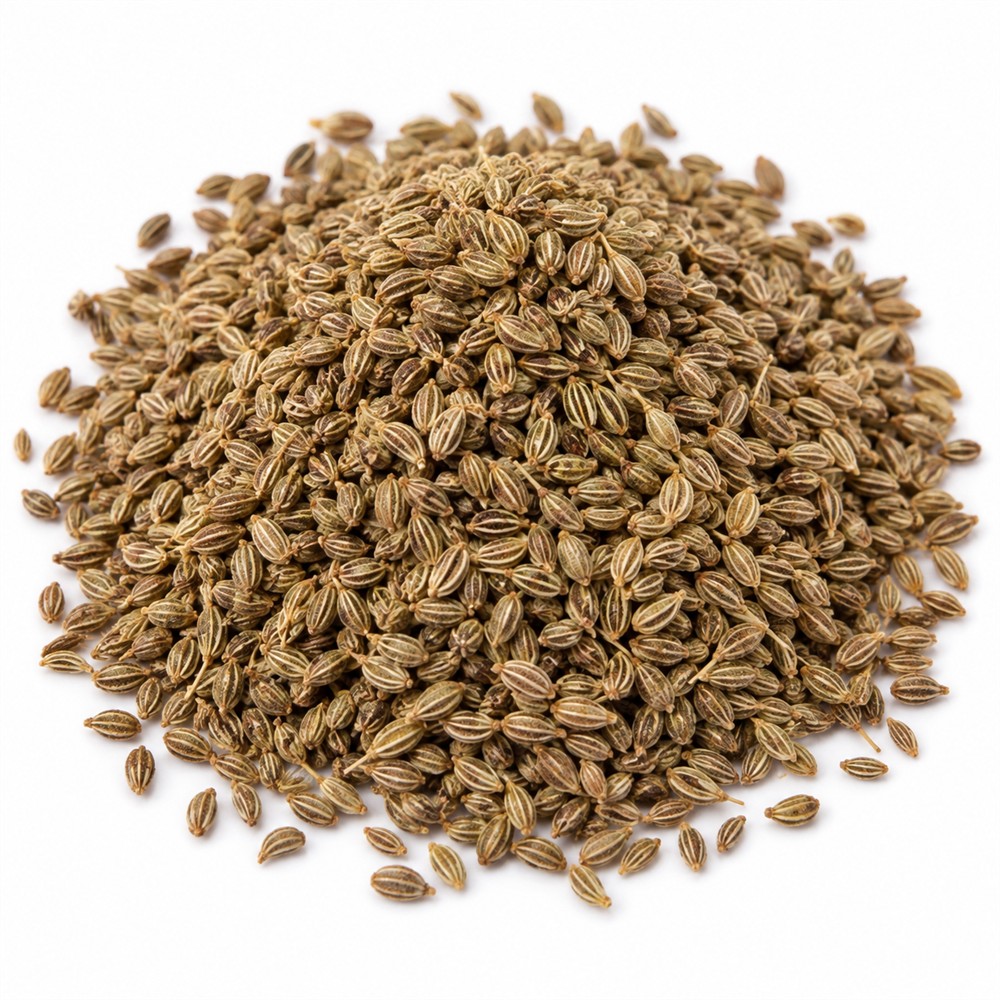
Ajwain (Carom Seeds)
Trachyspermum ammi (L.) Sprague
Bulk Ajwain (carom seed) in raw and cleaned grades, plus thymol-rich essential oil, for spice, pharma, nutraceutical and flavour buyers sourcing from India.
- Botanical nameTrachyspermum ammi (L.) Sprague
- Part usedDried ripe fruit (traded and referred to in commerce as seed)
- FamilyApiaceae (Umbelliferae)
- Also known asAjowan, Ajamoda, Yavani, Yamani, Omam, Vamu, Oma
- Certificate of Analysis
- Samples available
- Export documents handled
Ajwain is the dried ripe fruit of Trachyspermum ammi, sold commercially as a small ridged seed with a sharp, thyme-like aroma. India is the world's largest producer and exporter of this crop.
Botanical identity and part used
Ajwain belongs to the Apiaceae family, the same family as cumin, fennel and coriander. The plant is a slender annual herb, and the part that enters trade is the dried schizocarp fruit, commonly called a seed.
The seed's characteristic aroma comes from an essential oil concentrated in the pericarp, which is why crushing or grinding the seed releases a much sharper smell than the whole seed.
Where it grows in India
Gujarat and Rajasthan account for most of India's Ajwain cultivation, with additional acreage in Madhya Pradesh. The crop suits semi-arid tracts with light, well-drained soil and a dry finishing period before harvest.
Northern-belt sowing runs from September to November as a rabi crop, while parts of Andhra Pradesh, Karnataka and Tamil Nadu sow in August. The crop matures in 120 to 150 days depending on region and variety.
Harvest and processing
Plants are cut once the fruit umbels turn brown and the seed hardens, then dried and threshed to separate seed from stalk and chaff. Threshed seed is further sun-dried to bring moisture down to a stable trading level.
Cleaning removes stones, dust, broken seed and other crop seeds before bagging. A portion of the crop is steam-distilled for essential oil rather than sold as whole seed.
Why buyers source it
Ajwain's value lies in thymol, a phenolic monoterpene that gives the seed its antiseptic, sharp aroma and drives most of its pharmaceutical and flavour demand. Reported thymol content in Indian ajwain oil commonly runs from 35 to 60 per cent by GC, with the balance made up of p-cymene and gamma-terpinene.
Whole essential-oil content of the seed itself is typically 2 to 5 per cent by steam distillation, and buyers commissioning oil extraction size their seed order against this yield range. Thymol content can shift meaningfully with growing season and post-harvest handling, so buyers standardising a formulation should ask for a current-season assay rather than relying on historical figures.
Forms that trade
AV Biotech supplies Ajwain as raw farm-gate grade, cleaned and sortex-graded export seed, coarse-ground and fine powder, and steam-distilled essential oil. Organic-certified lots are arranged against advance contract.
Industry applications of Ajwain
Ajwain sells into food, pharmaceutical, flavour and personal-care manufacturing, and each segment buys a different cleaning grade or processed form.
Spice and food processing
Whole seed goes into spice blends, pickling mixes, bakery seasonings and snack-food coatings. Food manufacturers specify sortex-cleaned seed with low foreign-matter and stone content to protect packaging lines and finished-product appearance.
Ayurvedic and pharmaceutical manufacturing
Ajwain is used in classical Ayurvedic digestive formulations and in over-the-counter antacid and carminative products, generally as whole seed, coarse powder or a hydro-distillate. These buyers usually specify Indian Pharmacopoeia-aligned identity and purity testing.
Nutraceutical and supplement brands
Supplement makers use fine Ajwain powder in digestive-support capsules and blended herbal formulations, and use standardised thymol-rich extract or oil in encapsulated products. Buyers ask for a stated thymol percentage on the Certificate of Analysis.
Flavour, fragrance and essential-oil trade
Distillers and flavour houses buy seed specifically for oil extraction, where yield and thymol content decide the purchase price. Ajwain oil itself is sold onward to pharmaceutical, oral-care and flavour compounding buyers.
Cosmetic and personal care
Ajwain seed extract and oil appear in anti-dandruff, antimicrobial and scalp-care formulations, where thymol's aromatic and preservative-adjacent profile is the draw. Powder is also used in traditional ubtan and skin-cleansing blends.
Quality pitfalls buyers should check for
Ajwain is sometimes adulterated with other small umbelliferous seeds, such as wild celery or lovage seed, which resemble it visually but carry a different oil profile and lower thymol content. A simple crush-and-smell check, backed by a volatile-oil-content test, is the standard field screen before a lot is accepted.
Stone and mud-ball contamination is another recurring issue with raw farm-gate seed, which is why sortex cleaning and a stated foreign-matter limit matter more for Ajwain than for many other spice seeds.
Common product formats
- Raw and sortex-cleaned whole seed for spice trade
- Coarse and fine Ajwain powder for capsules and blends
- Steam-distilled Ajwain essential oil, thymol-rich
- Digestive churna, tablet and syrup formulations
- Flavour and fragrance compounding inputs
- Scalp-care and antimicrobial personal-care formulations
Traditional use and current research
Ajwain is classed in Ayurveda under Deepan and Pachan categories, meaning substances traditionally used to support digestive fire and digestion. It is also referenced under the Sanskrit name Yavani and Ajamoda in classical texts.
The points below describe traditional positioning and published research directions, not established medical outcomes.
Digestive comfort
Ajwain is the most widely recognised traditional remedy in Indian households for occasional indigestion and bloating, usually taken as a seed infusion. Studies suggest thymol and related compounds influence gastric and intestinal activity, supporting this long traditional use.
Respiratory and cough-related traditional use
Ajwain seed and its vapour are used traditionally for congestion relief, often as a steam inhalation or seed-and-jaggery preparation. Thymol's aromatic, warming character underlies this application.
Antimicrobial research interest
Ajwain essential oil has been studied in laboratory settings for activity against common bacterial and fungal strains, attributed mainly to its thymol and carvacrol content. This is a research finding, not a basis for a therapeutic claim on a finished product.
Topical and pain-related traditional use
Ajwain oil and poultices are used traditionally for topical application to sore muscles and joints. Formal clinical evidence for topical Ajwain preparations remains limited.
Oral and dental traditional use
Ajwain seed and its extract have a folk-medicine record for toothache relief and general oral hygiene, again attributed to thymol's antiseptic character. This has translated into modern herbal oral-care formulations built around the same traditional rationale.
What buyers should note on claims
Thymol content varies meaningfully between crop seasons, origins and extraction methods, so a specific research reference should be matched to a comparable assay range. A finished product's claim substantiation should rest on the manufacturer's own regulatory assessment.
This information is provided for educational and B2B product-sourcing purposes only. It is not medical advice and these statements have not been evaluated by any regulatory authority. Finished-product claims are the responsibility of the manufacturer.
| Botanical name | Trachyspermum ammi (L.) Sprague, Fam. Apiaceae |
|---|---|
| Part used | Dried ripe fruit (seed) |
| Appearance | Small ovoid ridged seeds, greyish-brown, strong thyme-like aroma; powder greyish-brown |
| Active constituents | Essential oil rich in thymol; whole seed typically yields 2 to 5 per cent volatile oil, with thymol content of 35 to 60 per cent by GC in the extracted oil |
| Purity | Not less than 99 per cent, free from admixture of other seeds |
| Moisture | Not more than 10 per cent (typical trade limit) |
| Total ash | Not more than 8 per cent (typical trade limit) |
| Acid-insoluble ash | Not more than 1.5 per cent (typical trade limit) |
| Foreign matter | Not more than 0.5 per cent for export/sortex grade; up to 2 per cent for raw farm-gate grade |
| Volatile oil content | Not less than 2 per cent by steam distillation (standard export grade) |
| Particle size | Whole seed standard; coarse powder and fine powder (60 to 80 mesh) on request |
| Pesticide/heavy-metal/microbial testing | Tested against EU and Codex MRLs on request; heavy metals within AYUSH limits; microbial testing including Salmonella and E. coli available for pharma and food buyers |
| Packing | 25 kg and 50 kg PP or jute bags with inner liner for whole seed; HDPE drums or glass containers for oil |
| Shelf life | 18 to 24 months for whole seed and powder in sealed original packing; 2 years for oil in a sealed, dark container |
| Note | All values are typical or indicative. Actual lot values vary with origin, season and grade, and are confirmed on the batch Certificate of Analysis |
Values are typical and indicative. A lot-specific Certificate of Analysis is shared before dispatch.
What is your minimum order quantity for Ajwain?
500 kg for raw or sortex-cleaned whole seed and 100 kg for powder. Essential oil starts at 5 kg. For trial and formulation work we supply 1 to 2 kg paid samples, adjusted against your first commercial order.
Can you supply seed with a guaranteed thymol content for oil extraction?
We supply seed against a stated volatile-oil-content range confirmed on the Certificate of Analysis, and we can arrange contract distillation with a GC-tested thymol percentage for buyers who want oil rather than raw seed.
What documentation comes with an export shipment?
Every lot ships with a batch Certificate of Analysis covering purity, moisture, ash values, foreign matter and volatile oil content. Export consignments also carry a phytosanitary certificate, Certificate of Origin, packing list and commercial invoice.
Can you customise cleaning grade, particle size or packing?
Yes. We supply raw farm-gate grade, sortex-cleaned export grade, and milled powder from 60 to 80 mesh. Packing can be adjusted to 25 kg or 50 kg bags, drums for oil, or your own private-label sacks.
What is the typical lead time and when is fresh crop available?
7 to 10 working days for stock grades from Jaipur. Fresh crop follows the rabi harvest, arriving in the market from February through April, and contracted volumes for the new season are best booked ahead of harvest.
Enquire about Ajwain (Carom Seeds)
No payment is taken here — this reaches our sourcing team directly.
Related products