Bhringraj
Bhringraj
Eclipta alba
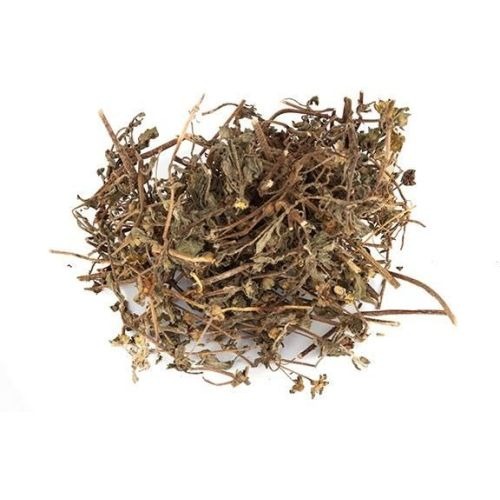
Bhringraj is the dried herb of Eclipta alba, supplied in bulk to hair oil makers, cosmetic formulators, Ayurvedic manufacturers and extract houses.
- Botanical nameEclipta alba
- Part usedWhole plant (aerial parts), leaves
- FamilyAsteraceae
- Also known asBhangra, Maka, Kesharaj, Karisalankanni, Bhringaraja
- Certificate of Analysis
- Samples available
- Export documents handled
Bhringraj is the dried whole plant of Eclipta alba, and it is one of the highest-volume herbs in Indian hair care. Buyers are hair oil manufacturers, cosmetic formulators, Ayurvedic pharma and extract houses.
Botanical identity
Eclipta alba (L.) Hassk. belongs to the Asteraceae family. The accepted botanical name is now Eclipta prostrata (L.) L., and both names appear on trade and INCI documentation.
It is a low, spreading annual herb with opposite lance-shaped leaves and small white flower heads. Crushed stems and leaves stain dark, which is part of the reason for its traditional association with hair.
Which Bhringraj you are actually buying
Ayurvedic literature describes three Bhringraj types by flower colour: Shweta or white, Peeta or yellow, and Neela or blue. The white type, Eclipta alba, is what the trade means by Bhringraj.
The yellow type is Wedelia calendulacea, a different plant altogether. Substitution of Eclipta alba with Wedelia calendulacea is documented in the crude drug market, and researchers have developed molecular marker methods specifically to separate the two.
This is the main identity risk in the material. Write botanical identity testing into your specification rather than relying on the trade name alone.
Growing regions and harvest
Bhringraj grows on moist ground, along paddy field bunds, canal banks and pond margins. Commercial supply comes largely from Madhya Pradesh, Uttar Pradesh and Gujarat, with further volumes from Maharashtra, Bihar and West Bengal.
The crop is harvested about 90 days after transplanting, at the early flowering stage. Reported yields reach around 8 tonnes per hectare fresh weight in the first cropping, with a lighter ratoon crop following.
Drying, and why colour matters
The aerial parts are cleaned and shade dried. This step is more commercially important for Bhringraj than for most herbs.
Shade drying preserves the green colour. Open-sun drying browns the leaf, and cosmetic buyers routinely reject off-colour powder because it changes the look of a hair pack or powder blend.
Because the plant is low-growing and cut close to wet ground, soil pick-up is the second common problem. It shows up as high acid-insoluble ash even when the material looks clean.
Active constituents
The marker compounds are the coumestans, principally wedelolactone and demethylwedelolactone. The plant also contains triterpene saponins including the ecliptasaponins.
Wedelolactone levels in dried whole herb are low, generally a fraction of one percent and variable by lot. Standardised extracts are produced at higher declared levels for buyers who need a guaranteed figure.
Forms that trade
We supply whole dried herb, cut and sifted material, and powder at 80 or 100 mesh. Cosmetic buyers usually want the finer mesh so the product feels smooth and leaves no grit.
Industry applications of Bhringraj
Bhringraj sells into cosmetic and Ayurvedic channels far more than into food. Mesh size and colour matter more here than in most herb categories.
Hair care and cosmetic manufacturing
This is the largest segment. Bhringraj is the defining herb of Bhringraj taila, the traditional infused hair oil, and it appears across modern hair care ranges.
Formulators use fine powder in hair masks, hair packs and powder cleansers, and use oil-soluble or water-soluble extract in shampoos, conditioners and serums. The INCI name usually declared is Eclipta Prostrata Leaf Extract or Eclipta Prostrata Extract.
Cosmetic buyers typically specify 100 mesh, a bright green colour and low microbial counts, since many finished formats are wash-off products with water present.
Ayurvedic and herbal pharma
Classical preparations built around the herb include Bhringrajasava, Bhringraj taila and Neelibhringadi taila. Manufacturers use coarse cut for oil infusion and decoction, and powder for churna and tablet lines.
Pharma buyers focus on botanical identity, foreign matter and ash, and will usually ask for HPTLC identity against a wedelolactone marker.
Nutraceutical and supplement brands
Supplement makers formulate Bhringraj extract into capsules and tablets positioned around hair wellness and liver wellness. This segment almost always buys standardised extract rather than plain powder.
Henna and hair colour blending
Henna and hair colour brands blend Bhringraj powder with henna, indigo, amla and shikakai. The blend is sold as a conditioning or darkening hair powder.
Buyers here order in large volumes and are extremely particular about mesh consistency and colour uniformity between lots, because any variation shows immediately in the packed product.
Extract manufacture
Extract houses buy leaf-rich material and produce water, hydro-alcoholic and oil-soluble extracts. Oil-soluble grades are specifically made for hair oil and serum manufacturers.
Common product formats
- Bhringraj hair oils and traditional infused tailas
- Hair masks, hair packs and powder hair cleansers
- Shampoos, conditioners and leave-in serums using extract
- Henna, indigo and amla hair colour blends
- Churna, asava and tablet formats in Ayurvedic manufacturing
- Hair and liver wellness capsules using standardised extract
Traditional uses and current research
Bhringraj holds a long-standing place in Ayurveda, where it is grouped with the keshya herbs, meaning those associated with hair. Its Sanskrit name Kesharaj reflects the same association.
Traditional positioning
Traditionally used in Ayurveda in preparations applied to the scalp and hair, most familiarly as a herb infused into oil. This topical use is by far its best-known traditional application.
Classical texts also group it among rasayana herbs and describe internal use in formulations directed at liver function. Bhringrajasava is the best-known internal preparation.
What studies suggest
Wedelolactone and demethylwedelolactone are the most investigated constituents. Laboratory studies suggest possible antioxidant activity, and some work has examined effects relevant to hair follicle biology in animal and cell models.
Research has also looked at extracts of the plant in relation to liver enzyme markers in preclinical models. Human evidence remains limited, and results should not be read as established outcomes.
Study preparations differ widely, from crude powders to standardised extracts to oil infusions. Findings from one preparation do not automatically transfer to another, so manufacturers should match their material to the evidence they intend to cite.
How brands position finished products
Commonly formulated into products targeting hair conditioning, scalp comfort, hair appearance and general Ayurvedic hair wellness. Cosmetic products are positioned on appearance and feel rather than on physiological outcomes.
Claim wording depends on whether the finished product is registered as a cosmetic, an Ayurvedic proprietary medicine or a food supplement. Each route has different permitted language in India and in export markets.
Points buyers should note
For wash-off cosmetic formats, microbial specification usually matters more than assay. For oil infusions, moisture control in the raw powder matters most, since residual water shortens the shelf life of the finished oil.
Formulators generally carry out patch testing and full safety assessment for topical products, and review internal-use suitability separately.
This information is provided for educational and B2B product-sourcing purposes only. It is not medical advice and these statements have not been evaluated by any regulatory authority. Finished-product claims are the responsibility of the manufacturer.
| Botanical name | Eclipta alba (L.) Hassk. (syn. Eclipta prostrata (L.) L.) |
|---|---|
| Family | Asteraceae |
| Part used | Dried whole plant / aerial parts; leaf-rich grade on request |
| INCI reference | Eclipta Prostrata Leaf Extract / Eclipta Prostrata Extract |
| Appearance | Green to dark green herb; powder medium to dark green. Brown tone indicates sun drying |
| Odour and taste | Faint characteristic odour; slightly bitter and acrid taste |
| Active constituents | Coumestans: wedelolactone and demethylwedelolactone; triterpene saponins (ecliptasaponins) |
| Wedelolactone (raw herb) | Low and variable, typically well under 0.5% on dry basis; confirmed lot by lot |
| Extract standardisation | 1% to 5% wedelolactone by HPLC, or total saponin basis, to buyer specification |
| Moisture | Not more than 10% (typical); not more than 8% preferred for oil infusion use |
| Total ash | Not more than 12% (typical) |
| Acid-insoluble ash | Not more than 3% (typical); the key indicator of field soil pick-up |
| Foreign matter | Not more than 2% (typical) |
| Botanical identity | HPTLC or marker-based identity to exclude Wedelia calendulacea substitution |
| Particle size | Whole herb; cut and sifted 2 to 8 mm; powder 60, 80 or 100 mesh. Cosmetic buyers usually take 100 mesh |
| Pesticide residues | Tested against buyer-nominated panel; EU or USP limits available on request |
| Heavy metals | Lead, cadmium, mercury and arsenic tested to agreed limits |
| Microbiology | Total plate count, yeast and mould, E. coli, Salmonella; tighter limits available for wash-off cosmetics |
| Packing | 25 kg PP or HDPE laminated bags with food-grade inner liner; fibre drums for fine powder |
| Shelf life | 24 months whole and cut; 12 to 18 months powder, in original sealed packing |
Values are typical and indicative. A lot-specific Certificate of Analysis is shared before dispatch.
What is your minimum order quantity for Bhringraj?
MOQ is 100 kg per grade for powder and cut and sifted material, and 500 kg for whole dried herb. Samples of 100 to 500 g are supplied so you can check colour, mesh and feel before committing, which matters for cosmetic buyers. Several grades can be consolidated into one shipment.
How do you confirm the material is Eclipta alba and not Wedelia calendulacea?
Substitution with Wedelia calendulacea, the yellow-flowered Peeta Bhringraj, is a documented problem in the crude drug trade. We source through identified collection channels and supply HPTLC or marker-based identity testing with the lot. We recommend you specify botanical identity testing in your purchase specification rather than relying on the trade name.
Can you supply 100 mesh cosmetic grade with consistent colour?
Yes. We mill to 60, 80 or 100 mesh, and 100 mesh is our standard cosmetic grade for hair packs and powder blends. Colour consistency comes from shade drying rather than milling, so we select shade-dried lots for cosmetic buyers. For repeat orders we can hold a retained reference sample and match subsequent lots against it.
Do you offer standardised Bhringraj extract?
Yes, in water-soluble and oil-soluble forms. Water-soluble grades suit shampoos, serums and capsules, while oil-soluble grades are made for hair oils and leave-in products. Standardisation is normally written against wedelolactone by HPLC, typically in the 1% to 5% range, or on a total saponin basis. Please state your assay method along with the percentage.
What is the lead time, and when is fresh crop available?
Ready stock in standard grades usually dispatches within 7 to 10 working days of confirmation. Custom mesh, colour matching or specific testing typically adds 10 to 15 days. Fresh material follows the main harvest cycle, with the first crop cut around mid-year and a lighter ratoon crop after it, so the freshest lots are available in the months following each cut.
Enquire about Bhringraj
No payment is taken here — this reaches our sourcing team directly.
Related products