Agarwood (Agaru)
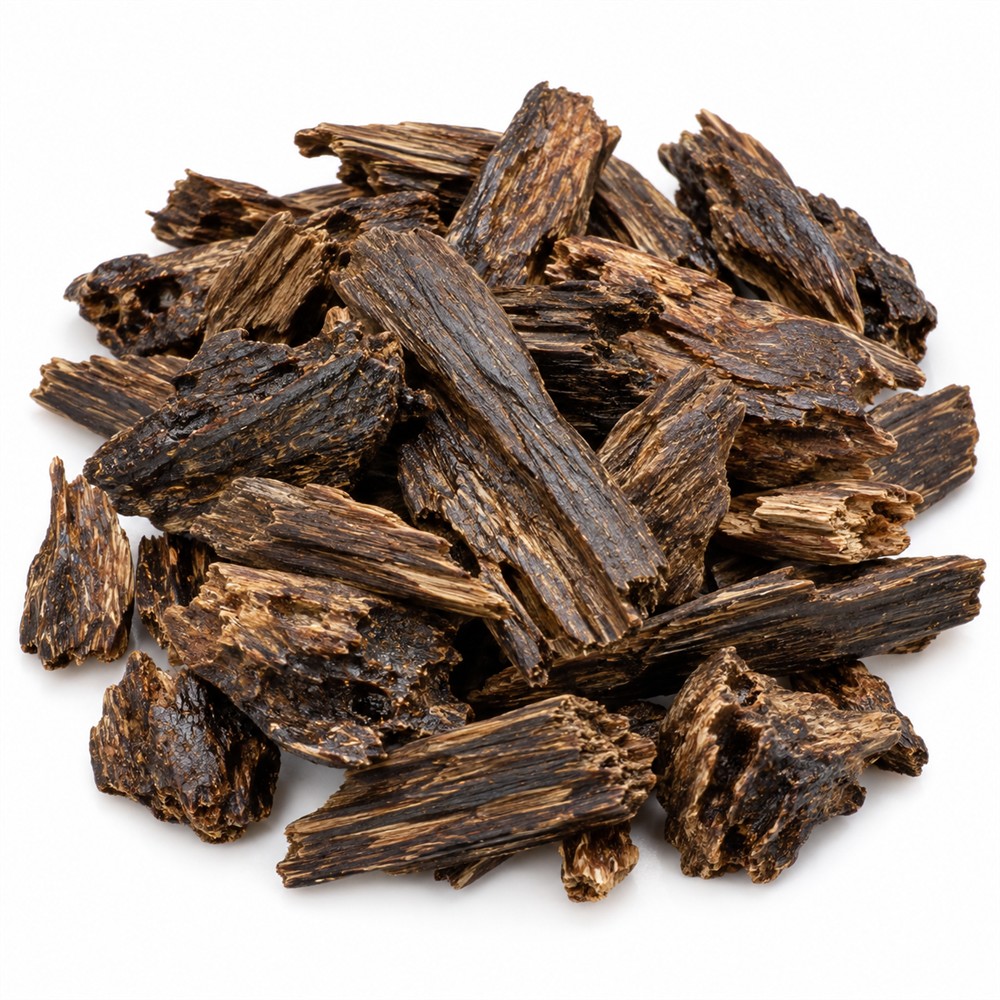
Agarwood (Agaru)
Aquilaria agallocha Roxb. (syn. Aquilaria malaccensis Lam.)
CITES-compliant Agarwood (Aquilaria agallocha) chips, powder and oil from Northeast India for perfumery, incense and Ayurvedic buyers, sold with full export permits.
- Botanical nameAquilaria agallocha Roxb. (syn. Aquilaria malaccensis Lam.)
- Part usedResin-infused heartwood; essential oil distilled from heartwood, chips and sawdust
- FamilyThymelaeaceae
- Also known asAgar, Agaru, Krishnagaru, Oud, Gaharu, Loh-Kyauk
- Certificate of Analysis
- Samples available
- Export documents handled
Agarwood is the dark, resin-saturated heartwood formed inside Aquilaria trees after injury or fungal infection. It is one of the most valuable traded plant materials in the world by weight, and one of the most tightly regulated.
Botanical identity and part used
The tree belongs to the Thymelaeaceae family. Healthy Aquilaria wood is pale, light and odourless. Agarwood forms only in wounded or infected trees, as the tree deposits aromatic resin around the injury as a defence response.
The commercial material is this resin-impregnated heartwood, along with chips, sawdust and powder graded from it, and the essential oil distilled from lower grades. Unaffected sapwood carries no trade value.
Where it grows in India
Assam is India's principal Agarwood-growing state, with further plantations in Manipur, Nagaland, Tripura and Meghalaya. The Aquilaria tree favours a humid climate with 1,800 to 3,500 mm annual rainfall and temperatures between 22 and 43 degrees C.
Most current Indian supply comes from cultivated plantations rather than wild forest trees, following decades of overharvesting that pushed wild populations into CITES protection.
Formation, harvest and grading
Naturally infected wild trees can take 15 to 20 years to develop workable resin deposits. Plantation growers now use artificial inoculation, wounding or fungal induction, to trigger resin formation earlier and more predictably across a stand.
Harvested wood is cut into chips and hand-sorted by resin saturation, colour and density. India follows a Triple Super, Double Super, Super, and A to D grading ladder, with the highest grades carrying the darkest colour and the most resin by visible cross-section.
The sink test and resin content
Resin-dense chips are denser than water and sink, while lower-resin chips float; this simple sink test is a standard first check buyers use before ordering lab analysis. Reported resin content for premium cultivated chips commonly runs in the 25 to 49 per cent range depending on grade and origin, verified by solvent extraction and GC-MS profiling.
CITES status and legal sourcing
Aquilaria malaccensis has been listed on CITES Appendix II since 1995, and Aquilaria agallocha is treated as part of the same regulated species complex in trade. Every export requires a CITES permit, and India's national export quota is reviewed periodically by the CITES Secretariat.
AV Biotech supplies only plantation-grown, legally sourced material with state forest department transit permits, CITES export permits and Non-Detriment Finding documentation matched to each consignment.
Forms that trade
Material is available as graded chips and chunks, powder and sawdust for incense manufacture, and hydrodistilled essential oil (agar attar or oud oil) for fine fragrance.
Industry applications of Agarwood
Agarwood moves through a narrow set of buyers because of its price point and its CITES paperwork requirement. Grade and form are matched closely to the end application.
Fine fragrance and perfumery
Perfume houses buy hydrodistilled or CO2-extracted oil, known in trade as oud oil or agar attar, as a base note in luxury fragrances. Buyers specify oil origin, distillation method and a GC-MS chromone and sesquiterpene profile before committing to a lot.
Incense and agarbatti manufacturing
Lower and mid-grade chips, sawdust and powder go into hand-rolled incense sticks, cones and dhoop, particularly for the Gulf, Southeast Asian and Indian religious-goods markets. Powder fineness and burn characteristics matter more here than trace-compound assay.
Ayurvedic and Unani formulation
Agaru is described in classical Ayurvedic texts and is used in select churna, taila and dhoopan (fumigation) preparations, and in Unani formulations. These buyers want documented botanical identity and want the wood free of synthetic oil re-infusion, a known adulteration practice in the lower end of the trade.
Religious and ceremonial goods
Whole chips and chunks are sold for direct burning in temples, mosques and private ceremonial use across the Middle East, South Asia and East Asia. Buyers in this segment often specify grade and piece size rather than a chemical assay.
Cosmetic and wellness formulation
Small volumes of Agarwood oil and hydrosol go into premium skincare, hair oils and aromatherapy blends, where the wood's fragrance profile is the primary selling point.
Quality checks buyers should run before committing
Synthetic-oil re-infusion is the most common adulteration in the lower end of the Agarwood trade, where cheap, low-resin wood is soaked in artificial oud fragrance to mimic a higher grade. A GC-MS profile checked against known chromone and sesquiterpene markers is the most reliable way to catch this before a shipment is confirmed.
Buyers should also ask for the sink-test result on chip lots and cross-check it against the stated grade, since floating material sold at a sinking-grade price is a recurring complaint in the trade. A physical pre-shipment sample, not just a photograph, is worth insisting on for first orders.
Common product formats
- Graded chips and chunks (Super, Double Super, Triple Super, A to D)
- Coarse and fine powder for agarbatti and dhoop manufacture
- Sawdust for incense cone and briquette production
- Hydrodistilled and CO2-extracted Agarwood oil (oud oil, agar attar)
- Agarwood hydrosol for cosmetic use
- Classical Ayurvedic and Unani formulation inputs
Traditional use and current research
Agaru appears in classical Ayurvedic and Unani texts as a warming, aromatic substance used in fumigation and select formulations. It is also described in Traditional Chinese Medicine under the name chen xiang.
The notes below describe traditional positioning and published research directions. They are not claims about a finished consumer product.
Traditional aromatic and calming use
Agarwood smoke and oil have a long history of ceremonial and calming use across South Asian, Middle Eastern and East Asian traditions. This use is aromatic and ritual in nature rather than a documented therapeutic indication.
Research on sesquiterpene and chromone constituents
Published phytochemical work has focused on the sesquiterpenes, including agarospirol, jinkoh-eremol and guaiol, and on 2-(2-phenylethyl)chromone compounds that are unique to genuine Agarwood resin. Researchers use these compounds to authenticate real Agarwood and to study its pharmacological potential.
Digestive and respiratory traditional use
Some classical and folk sources describe Agaru use in digestive and respiratory contexts. Modern clinical evidence in this area is limited, and buyers should not extend traditional descriptions into disease-related claims.
Cross-cultural aromatic and ritual significance
Agarwood holds parallel status across multiple traditions, valued in Middle Eastern oud culture, Japanese kōdō incense ceremony, Buddhist and Hindu ritual practice, and Traditional Chinese Medicine. This breadth of independent traditional use is part of why the material commands consistent global demand despite its high price and regulatory burden.
What buyers should note on claims
Agarwood's commercial value is driven overwhelmingly by fragrance and resin content, not by a standardised health claim. Any wellness positioning for a finished product should be built on the manufacturer's own regulatory review, not on traditional aromatic use alone. Grade and resin content, not a health claim, remain the primary commercial differentiators buyers should evaluate.
This information is provided for educational and B2B product-sourcing purposes only. It is not medical advice and these statements have not been evaluated by any regulatory authority. Finished-product claims are the responsibility of the manufacturer.
| Botanical name | Aquilaria agallocha Roxb. (syn. Aquilaria malaccensis Lam.), Fam. Thymelaeaceae |
|---|---|
| Part used | Resin-impregnated heartwood; oil distilled from heartwood, chips and sawdust |
| Appearance | Chips and chunks dark brown to near-black with visible resin streaking; powder brown to dark brown; oil deep amber to dark brown, viscous |
| Grade system | Triple Super, Double Super, Super, and Grade A to D, assigned by resin saturation, colour and density (India trade convention) |
| Active constituents | Sesquiterpenes (agarospirol, jinkoh-eremol, guaiol, aristolene) and 2-(2-phenylethyl)chromones; premium cultivated chips typically 25 to 49 per cent total resin content by solvent extraction |
| Resin/density check | Sink test in water used as a first-pass grading indicator; higher grades sink, lower grades float |
| Moisture | Not more than 5 per cent for graded chips and powder (typical trade limit) |
| Foreign matter | Not more than 2 per cent; free of sapwood, bark and non-resinous wood in graded material |
| Particle size | Whole chips and chunks (assorted sizes), coarse powder and fine sifted powder (40 to 100 mesh) for incense manufacture |
| Oil analysis | GC-MS chromone and sesquiterpene profile provided per batch; specific gravity and refractive index on request |
| Pesticide/heavy-metal/microbial testing | Tested against destination-market MRLs and AYUSH heavy-metal limits on request; microbial testing available for powder intended for incense or cosmetic use |
| Legal-origin documentation | CITES export permit, state forest department transit pass and Non-Detriment Finding reference issued with every export consignment |
| Packing | Sealed tins or vacuum-sealed pouches for chips and powder, by weight (10 g to 1 kg retail-adjacent lots, bulk kg lots for industrial buyers); glass vials with tamper-evident seals for oil |
| Shelf life | Indefinite for chips and chunks if kept dry; 3 to 5 years for oil in a sealed, dark container away from heat |
| Note | All values are typical or indicative. Actual lot values vary with origin, tree age and grade, and are confirmed on the batch Certificate of Analysis and CITES documentation |
Values are typical and indicative. A lot-specific Certificate of Analysis is shared before dispatch.
What is your minimum order quantity for Agarwood?
500 g for graded chips or powder trial lots and 5 kg for confirmed commercial orders. Oil is available from 10 ml for evaluation. Every shipment, regardless of size, carries the required CITES export documentation.
How do you prove legal origin for CITES-listed material?
Each consignment ships with a CITES export permit, a state forest department transit pass confirming plantation or approved-source origin, and a reference to the applicable Non-Detriment Finding. We do not supply wild-harvested material without complete documentation.
How is Agarwood grade determined, and can I request a specific grade?
Grade is set by resin saturation, colour and density, following the Super to Grade D ladder used in Indian trade. We can supply against a specified grade or a target resin-content range, confirmed against a photograph and sample before shipment.
What documentation and testing come with an oil shipment?
Oil ships with a Certificate of Analysis including specific gravity and a GC-MS chromone and sesquiterpene profile, alongside the CITES export permit, Certificate of Origin and commercial invoice. Additional heavy-metal or microbial testing is available on request for cosmetic-grade orders.
What is the typical lead time for an Agarwood order?
7 to 15 working days for stock chips and powder grades once documentation is confirmed. Custom grade sorting, larger oil-distillation runs and destination-specific CITES paperwork can extend this to 3 to 4 weeks.
Enquire about Agarwood (Agaru)
No payment is taken here — this reaches our sourcing team directly.
Related products