Aloe Vera (Ghritkumari)
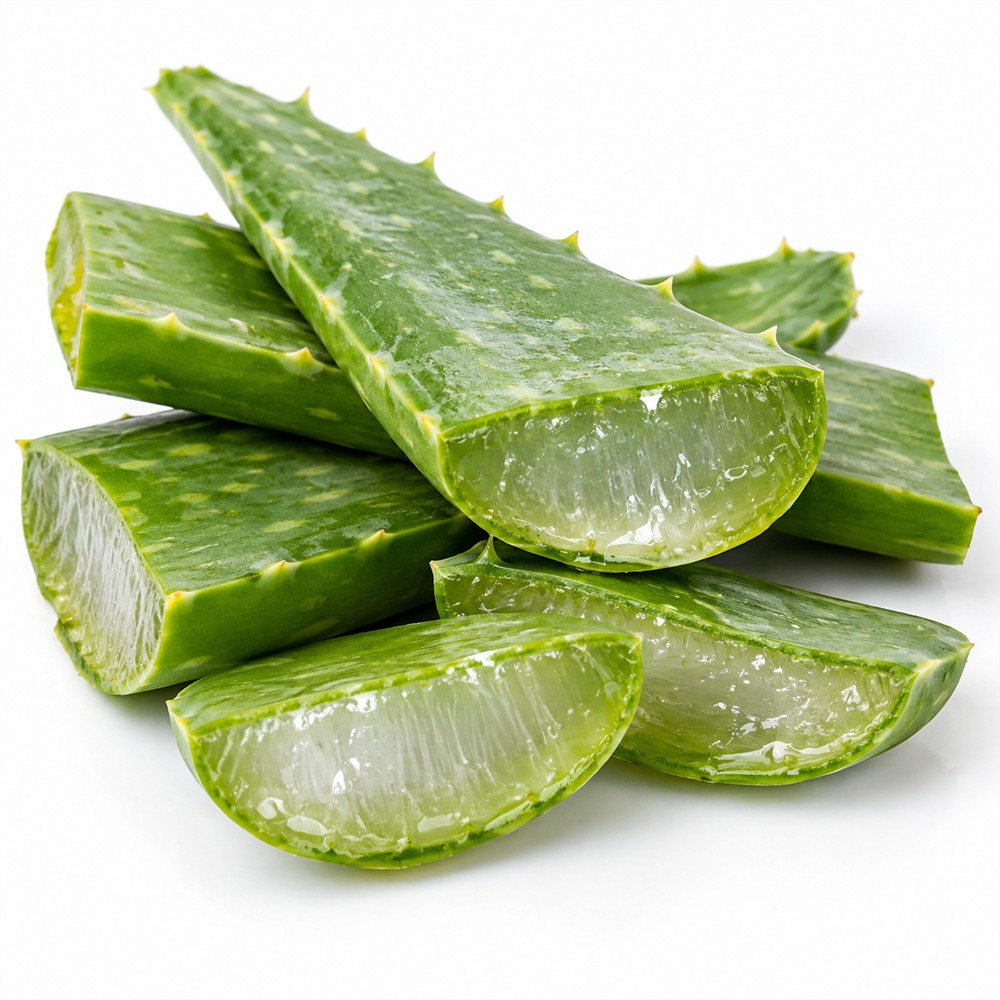
Aloe Vera (Ghritkumari)
Aloe barbadensis Mill. (syn. Aloe vera (L.) Burm.f.)
Bulk Aloe vera leaf powder, freeze-dried gel powder and concentrate for nutraceutical, cosmetic and Ayurvedic manufacturers sourcing from Rajasthan, India.
- Botanical nameAloe barbadensis Mill. (syn. Aloe vera (L.) Burm.f.)
- Part usedLeaf (inner fillet/gel and whole-leaf juice); dried leaf exudate (Musabbar) traded separately
- FamilyAsphodelaceae (Liliaceae)
- Also known asGhritkumari, Kumari, Kunwar Gandal, Musabbar (dried leaf exudate)
- Certificate of Analysis
- Samples available
- Export documents handled
Aloe vera is the succulent leaf of Aloe barbadensis, processed into gel powder, whole-leaf powder and concentrate for use across supplement, cosmetic and Ayurvedic manufacturing. It is one of the highest-volume botanical ingredients traded globally.
Botanical identity and part used
Aloe belongs to the Asphodelaceae family and grows as a rosette of thick, fleshy, spine-edged leaves. The Ayurvedic Pharmacopoeia of India recognises the plant under the name Kanyasara.
Two distinct materials come from the same leaf. The inner fillet or gel is processed into polysaccharide-rich powder and juice, while the yellow latex just under the rind, dried into a resin called Musabbar, is a separate, aloin-rich product with different applications.
Where it grows in India
Rajasthan, Gujarat, Andhra Pradesh and Tamil Nadu are India's principal Aloe vera growing states. Within Rajasthan, cultivation is concentrated in Ajmer, Bikaner, Barmer, Jodhpur, Nagaur and the Shekhawati belt covering Jhunjhunu, Sikar and Churu, where the dry climate keeps pest and fungal pressure low.
Leaves become harvestable from the second year of planting, and an established plantation can be harvested three to four times a year, with three to four mature outer leaves removed per plant per cycle. A single planting can be productive for four to five years.
Processing and grading
Harvested leaves are washed, filleted to separate gel from rind, and the gel is filtered, pasteurised and either concentrated or freeze-dried into powder graded by concentration ratio, commonly labelled 100X or 200X against the original juice.
A critical processing step is decolorization, which uses activated-carbon filtration to strip the leaf's natural aloin content down to trace levels for oral and topical products. Non-decolorized whole-leaf juice can carry aloin in the range of 10,000 to 20,000 ppm, against an industry ceiling of not more than 10 ppm aloin A and B in decolorized material intended for consumption.
Why buyers source it
The commercial value sits in acemannan and related long-chain polysaccharides, alongside amino acids, vitamins and trace minerals. Buyers verify polysaccharide content and confirm decolorization status before use in oral products, since the two aloe materials are not interchangeable.
Forms that trade
AV Biotech supplies Aloe vera as spray-dried and freeze-dried leaf powder (100X and 200X), concentrated juice, and dried Musabbar resin. Organic-certified and IASC-aligned lots are available against advance contract.
Industry applications of Aloe vera
Aloe vera moves into supplement, cosmetic, food and Ayurvedic manufacturing, and buyers choose between decolorized and non-decolorized material depending on the application.
Nutraceutical and supplement brands
Supplement manufacturers buy decolorized freeze-dried powder for capsules, tablets and drink-mix sachets, and concentrated juice for bottled functional beverages. These buyers require an aloin certificate confirming levels below the accepted oral-use limit.
Cosmetic and personal care
Formulators use 100X and 200X gel powder in moisturisers, after-sun products, hair-care formulations and sheet masks, where polysaccharide content and a clean, low-odour profile drive purchasing decisions. Aloin level matters less here but is still checked for skin-sensitivity reasons.
Ayurvedic and pharmaceutical manufacturing
Classical units use whole leaf pulp for Kumaryasava and related formulations, and separately source the dried Musabbar resin, which carries a concentrated aloin and anthraquinone content used differently from gel-based products.
Food and beverage manufacturing
Aloe features in functional drinks, juices, yoghurts and confectionery, where decolorized, low-odour powder or concentrate with confirmed food-safety testing is required.
Veterinary and animal care
Aloe leaf powder and juice are used in veterinary skin-care products and some animal-feed supplement formulations.
Quality pitfalls buyers should check for
Powder adulterated with maltodextrin or other cheap fillers is a known issue in the lower end of the aloe trade, since it is difficult to detect by eye once diluted into a formulation. A polysaccharide or solids-content test against the supplier's claimed concentration ratio is the practical check before scaling an order.
Buyers sourcing for oral products should always confirm decolorization status in writing and request the batch aloin result, rather than assuming powder labelled simply as aloe vera is automatically suitable for ingestion.
Common product formats
- Capsules, tablets and drink-mix sachets using decolorized 100X/200X powder
- Bottled and canned functional beverages using concentrated juice
- Moisturisers, gels, after-sun and hair-care cosmetic formulations
- Kumaryasava and other classical Ayurvedic liquid formulations
- Musabbar-based Ayurvedic and Unani preparations
- Wet wipes, facial tissue and personal-care coatings
Traditional use and current research
Aloe vera is described in Ayurveda under the name Kanyasara and Kumari, with traditional use centred on digestion, skin and general wellness. Modern research has focused mainly on its polysaccharide and topical properties.
The following notes describe traditional positioning and published research directions, not established medical outcomes.
Skin and topical traditional use
Aloe gel has the longest and most widely recognised traditional use for soothing skin after sun exposure and minor topical discomfort. This use is reflected in the large cosmetic and personal-care market for aloe-based products.
Digestive traditional use
Ayurvedic formulations such as Kumaryasava use Aloe vera pulp in digestive and women's health contexts. This traditional use is formulation-specific and should not be generalised to raw leaf material without the same preparation method.
Polysaccharide and immune-related research
Acemannan and related polysaccharides have been studied for immune-modulating and wound-related activity in laboratory and preliminary clinical settings. This remains an active research area rather than an approved therapeutic claim.
Aloin and internal-use caution
Non-decolorized aloe latex contains aloin, an anthraquinone glycoside with a traditional laxative use, but it also carries safety concerns at higher exposure levels. Regulatory and industry bodies restrict aloin content in products intended for oral consumption, which is why decolorization status must be confirmed for any ingestible formulation.
Oral and mucosal traditional use
Aloe pulp and juice have a traditional record of use for mouth ulcers and general oral comfort, generally as a mild gel application rather than a swallowed dose. This use is separate from the internal digestive use of Kumaryasava-type formulations.
What buyers should note on claims
Aloe vera claims should always specify which material, gel-based decolorized powder, non-decolorized whole-leaf juice, or Musabbar resin, is being referenced. A claim substantiated for one material cannot be assumed to apply to another.
This information is provided for educational and B2B product-sourcing purposes only. It is not medical advice and these statements have not been evaluated by any regulatory authority. Finished-product claims are the responsibility of the manufacturer.
| Botanical name | Aloe barbadensis Mill. (syn. Aloe vera (L.) Burm.f.), Fam. Asphodelaceae |
|---|---|
| Part used | Inner leaf fillet/gel (powder and juice); dried leaf exudate (Musabbar) quoted separately |
| Appearance | Powder off-white to light beige, fine and hygroscopic; concentrate pale yellow to colourless liquid; Musabbar dark brown to black brittle resin |
| Active constituents | Acemannan and related long-chain polysaccharides; freeze-dried gel powder commonly supplied as 100X or 200X concentration relative to fresh juice |
| Aloin (decolorized grade) | Not more than 10 ppm aloin A and B combined (industry standard for oral-use decolorized material) |
| Aloin (non-decolorized whole-leaf juice) | Naturally in the range of 10,000 to 20,000 ppm before processing; not used in oral products without decolorization |
| Moisture | Not more than 8 per cent for freeze-dried powder (typical trade limit) |
| Total ash | Not more than 15 per cent for whole-leaf powder (typical trade limit, reflecting natural mineral content) |
| Foreign matter | Not more than 1 per cent |
| Particle size | Fine powder, typically 80 to 100 mesh; concentrate supplied by degrees Brix on request |
| Pesticide/heavy-metal/microbial testing | Tested against EU MRL and AYUSH heavy-metal limits on request; microbial testing including total plate count, yeast/mould and Salmonella available for food, cosmetic and pharma buyers |
| Packing | 20 kg and 25 kg fibre drums or foil-lined bags for powder; food-grade drums or IBC totes for concentrate |
| Shelf life | 24 months for freeze-dried powder in sealed original packing; 12 to 18 months for liquid concentrate under recommended cold-chain storage |
| Note | All values are typical or indicative. Actual lot values vary with origin, processing method and grade, and are confirmed on the batch Certificate of Analysis |
Values are typical and indicative. A lot-specific Certificate of Analysis is shared before dispatch.
What is your minimum order quantity for Aloe vera?
50 kg for freeze-dried powder, 200 litres for liquid concentrate and 25 kg for Musabbar resin. For trial and formulation work we supply smaller paid samples, adjusted against your first commercial order.
What is the difference between decolorized and non-decolorized Aloe vera, and which do I need?
Decolorized material has aloin reduced to below 10 ppm through carbon filtration and is required for oral products such as capsules and beverages. Non-decolorized whole-leaf material retains natural aloin and is generally restricted to topical or industrial use. Tell us your end application and we will recommend the correct grade.
What documentation comes with an export shipment?
Every lot ships with a batch Certificate of Analysis covering aloin content, moisture, microbial testing and, where applicable, polysaccharide indicators. Export consignments also carry a phytosanitary certificate, Certificate of Origin, packing list and commercial invoice.
Can you supply a specific concentration ratio or customise packing?
Yes. We supply 100X and 200X freeze-dried powder and concentrate to a specified Brix level, and can pack in fibre drums, foil-lined bags or your own private-label containers, including smaller retail-adjacent sizes on larger orders.
What is the typical lead time?
10 to 15 working days for stock powder and concentrate grades from Jaipur. Organic-certified lots and custom concentration ratios take 3 to 4 weeks, and peak leaf availability follows the main harvest cycles through the year.
Enquire about Aloe Vera (Ghritkumari)
No payment is taken here — this reaches our sourcing team directly.
Related products