Butterfly Pea (Aparajita)
Butterfly Pea (Aparajita)
Clitoria ternatea L.
Shade-dried butterfly pea flower (Clitoria ternatea), whole and powder grades, for natural blue colorant, beverage and Ayurvedic manufacturers sourcing from India.
- Botanical nameClitoria ternatea L.
- Part usedFlower (primary trade grade for colour and beverage use); root, seed and leaf traded separately for Ayurvedic use
- FamilyFabaceae
- Also known asAparajita, Shankhpushpi (regional usage), Girikarnika, Kakkattan
- Certificate of Analysis
- Samples available
- Export documents handled
Butterfly Pea, called Aparajita in Sanskrit and Hindi, is the flower of Clitoria ternatea, a twining leguminous vine of the Fabaceae family. It has become the most widely traded natural blue colour source in the food and beverage industry, alongside a long-standing place in Ayurvedic practice.
Botanical identity and part used
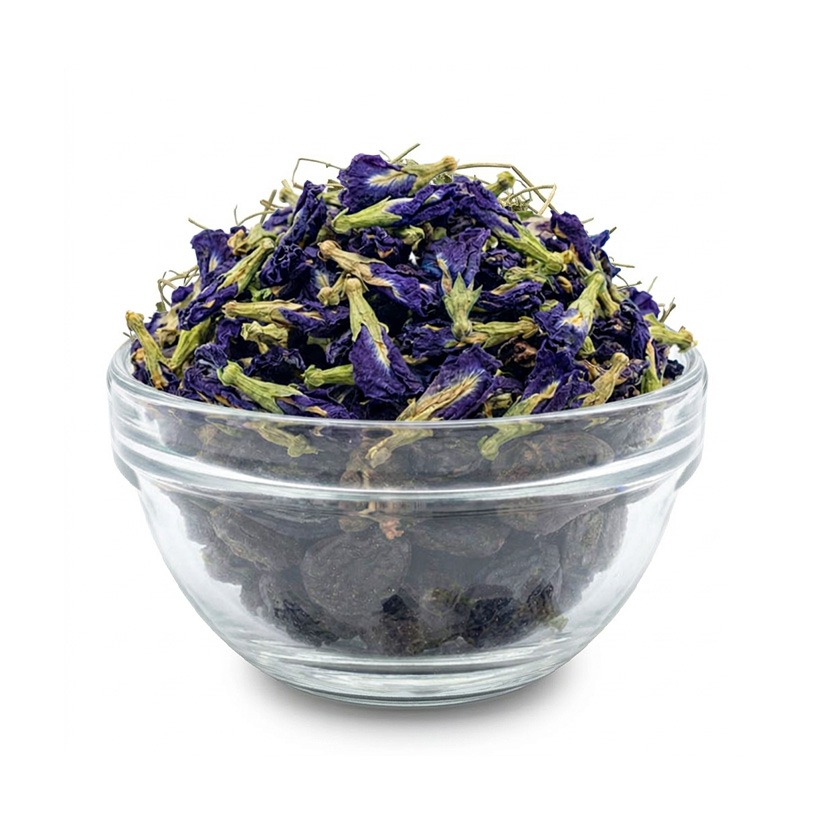
The vine produces distinctive deep blue, funnel-shaped flowers, occasionally in white or light purple forms, with the shape giving rise to the conch-flower and butterfly-pea names. The commercial colour and beverage trade uses the flower exclusively; root, seed and leaf are separate trade items used in Ayurvedic formulation and are not interchangeable with flower in a colour-grade specification.
Where it grows in India
Clitoria ternatea grows across tropical and subtropical India, with organised cultivation concentrated in Kerala, Karnataka, Tamil Nadu and parts of Andhra Pradesh, and wider naturalised occurrence recorded from Uttar Pradesh, Assam, Bihar, Madhya Pradesh, West Bengal, Gujarat and Jammu and Kashmir. It tolerates a range of soils and is often grown as an intercrop or field-border planting.
Harvest and processing
Flowers are hand-picked in early morning, when pigment concentration is reported to be highest before heat and sunlight begin to degrade the anthocyanins. Freshly picked flowers are shade-dried on raised racks or in controlled low-temperature drying, generally in the 40 to 50 degrees Celsius range, since direct sun and high heat degrade both colour intensity and the ternatin anthocyanins responsible for it.
Correctly dried flowers retain a deep indigo-blue colour; flowers that turn dull, brownish or faded during drying are a visible sign of poor post-harvest handling and are downgraded or rejected.
Why buyers source it
The flower's blue colour comes from ternatins, a family of polyacylated anthocyanins, alongside delphinidin-based pigments, that shift from blue toward purple and pink as pH drops, a property beverage formulators use deliberately for colour-change drink effects. This pH-responsive, plant-derived blue has driven strong demand from food and beverage brands replacing synthetic blue dyes.
Forms that trade
AV Biotech supplies whole dried flowers and milled flower powder, with lots screened for colour intensity, moisture and foreign matter, and can arrange extract-grade or standardised colour concentrate against contract for larger beverage-industry buyers.
Industry applications of Butterfly Pea
Butterfly Pea moves into three main buyer categories, and colour retention is the deciding quality factor for two of them.
Natural food and beverage colorant manufacturing
This is the largest and fastest-growing buyer segment. Food and beverage manufacturers use whole flower infusions and flower-powder extracts to replace synthetic blue dyes (such as FD&C Blue 1) in teas, mocktails, sports drinks, carbonated beverages, coffee creamers, ice cream, yogurt, gummies, coated confectionery and chewing gum.
Formulators value the pH-driven colour shift from blue to purple to pink, which is used deliberately in colour-change drink and confectionery products. Buyers in this segment specify colour intensity (often described qualitatively or by anthocyanin content) and consistent batch-to-batch shade.
Ayurvedic and nutraceutical manufacturing
Aparajita is used in Ayurveda as a Medhya Rasayana, a category of herbs traditionally associated with brain and memory support, and appears as a named ingredient in classical brain-tonic formulations. Root, seed and whole-plant material are used here in addition to flower, and buyers in this segment usually specify plant part clearly since Ayurvedic use is not limited to flower alone.
Cosmetic and personal-care formulation
Flower extract and powder are used in hair-care and skin-care formulations, marketed around traditional use and the visual appeal of the natural blue pigment, particularly in clay masks, hair rinses and colour-changing personal-care novelties.
Textile and craft dye use
A smaller volume moves into natural textile dyeing and craft applications, where the same pH-sensitive pigment behaviour is used for colour effects on fabric.
Common product formats
- Butterfly pea flower tea, loose and tea-bag grade
- Blue colour extract and standardised concentrate for beverages
- Colour-change mocktail and cocktail premixes
- Gummies, hard candy and confectionery colouring
- Hair rinses, clay masks and colour-changing cosmetics
- Medhya Rasayana and classical Ayurvedic brain-tonic formulations
Traditional use and current research
Aparajita is classified in Ayurveda as a Medhya Rasayana, a category of rejuvenative herbs traditionally associated with memory and cognitive function, and is named as a constituent in classical brain-tonic (Medhya Rasayana) formulations. The following notes describe traditional positioning and published research directions, not established medical outcomes.
Cognitive and memory-support positioning
Traditional Ayurvedic use positions Aparajita root, seed and whole-plant material as a support for memory and mental clarity. Some published studies have examined extracts for effects on markers related to cognitive function, most commonly in animal models, and brands formulate flower and extract into memory- and focus-positioned products on this traditional basis.
Antioxidant research on the flower pigment
The ternatin anthocyanins responsible for the flower's blue colour are also studied for antioxidant activity in laboratory assays. This is a property of the isolated pigment under test conditions, not a demonstrated health outcome from consuming the flower or a coloured beverage.
General wellness and traditional tonic use
Regional traditional medicine uses Aparajita more broadly as a mild tonic, alongside its established role as a natural colorant. This reflects long traditional use rather than clinical evidence for a specific outcome.
What buyers should note on claims
Most published human-relevant research on Clitoria ternatea is preliminary, and the bulk of commercial demand for the flower is driven by its colour properties rather than its traditional cognitive-support use. Formulators building a claim on cognitive or antioxidant research should confirm which plant part and preparation the cited study actually used.
This information is provided for educational and B2B product-sourcing purposes only. It is not medical advice and these statements have not been evaluated by any regulatory authority. Finished-product claims are the responsibility of the manufacturer.
| Botanical name | Clitoria ternatea L., Fam. Fabaceae |
|---|---|
| Part used | Dried flower (colour and beverage grade); root, seed and leaf quoted separately for Ayurvedic use |
| Appearance | Deep indigo-blue dried flowers, funnel-shaped; powder deep blue to blue-violet |
| Active constituents | Ternatin anthocyanins (polyacylated delphinidin glycosides, series A1-A3, B1-B4, C1-C5, D1-D3) and delphinidin derivatives; total anthocyanin content reported widely across studies (indicative range roughly 0 to 70+ mg/100 g depending on extraction method and analysis), confirmed per batch on request |
| Moisture | Not more than 10 per cent (typical trade limit for dried flower) |
| Total ash | Not more than 8 per cent (indicative) |
| Acid-insoluble ash | Not more than 1.5 per cent (indicative) |
| Foreign matter | Not more than 2 per cent; discoloured/faded flowers excluded at grading |
| Colour quality | Assessed visually and, for colour-grade lots, by pH-shift colour test and/or spectrophotometric reading on request |
| Particle size | Whole dried flower standard; powder milled to 60 to 100 mesh on request |
| Pesticide/heavy-metal/microbial testing | Pesticide residues against EU MRL panel, heavy metals against AYUSH/Codex limits, microbiology (total plate count, yeast and mould, Salmonella, E. coli) available per lot on request |
| Packing | Multi-layer food-grade pouches or HDPE bags, light-protected packing recommended to preserve colour; 5 kg to 25 kg standard |
| Shelf life | 18 to 24 months from date of packing, stored dry, dark and cool to preserve colour intensity |
| Note | All values are typical or indicative. Actual lot values vary with origin, drying method and season, and are confirmed on the batch Certificate of Analysis |
Values are typical and indicative. A lot-specific Certificate of Analysis is shared before dispatch.
What is your minimum order quantity for butterfly pea flower?
10 kg for whole dried flowers and 5 kg for milled powder. Extract or standardised colour concentrate is quoted separately once your target colour intensity is confirmed. Paid samples of 100 g to 250 g are available for trial brewing or formulation.
Can you supply flower graded specifically for colour intensity, for beverage use?
Yes. We screen lots visually for a deep indigo-blue shade and exclude faded or brown-tinged flowers at grading. For beverage manufacturers we can also arrange a pH-shift colour test or spectrophotometric reading on the specific batch before shipment.
Do you supply root or seed, since Ayurvedic use isn't limited to the flower?
Yes, root and seed are available as separate trade items and quoted independently of flower, since Ayurvedic formulations often specify a different plant part than the colour and beverage trade uses. Please specify the plant part you need at enquiry.
What documentation comes with an export shipment?
Every lot ships with a batch Certificate of Analysis covering moisture, ash values and available anthocyanin data. Export consignments also carry a phytosanitary certificate, Certificate of Origin, packing list and commercial invoice.
How should butterfly pea flower be stored to protect the colour, and what's the shelf life?
18 to 24 months from packing date when kept dry, dark and cool in sealed original packing. Light exposure is the main cause of colour fade in storage, so we recommend keeping product in its light-protected packaging until use.
Enquire about Butterfly Pea (Aparajita)
No payment is taken here — this reaches our sourcing team directly.
Related products