Galangal (Kulanjan)
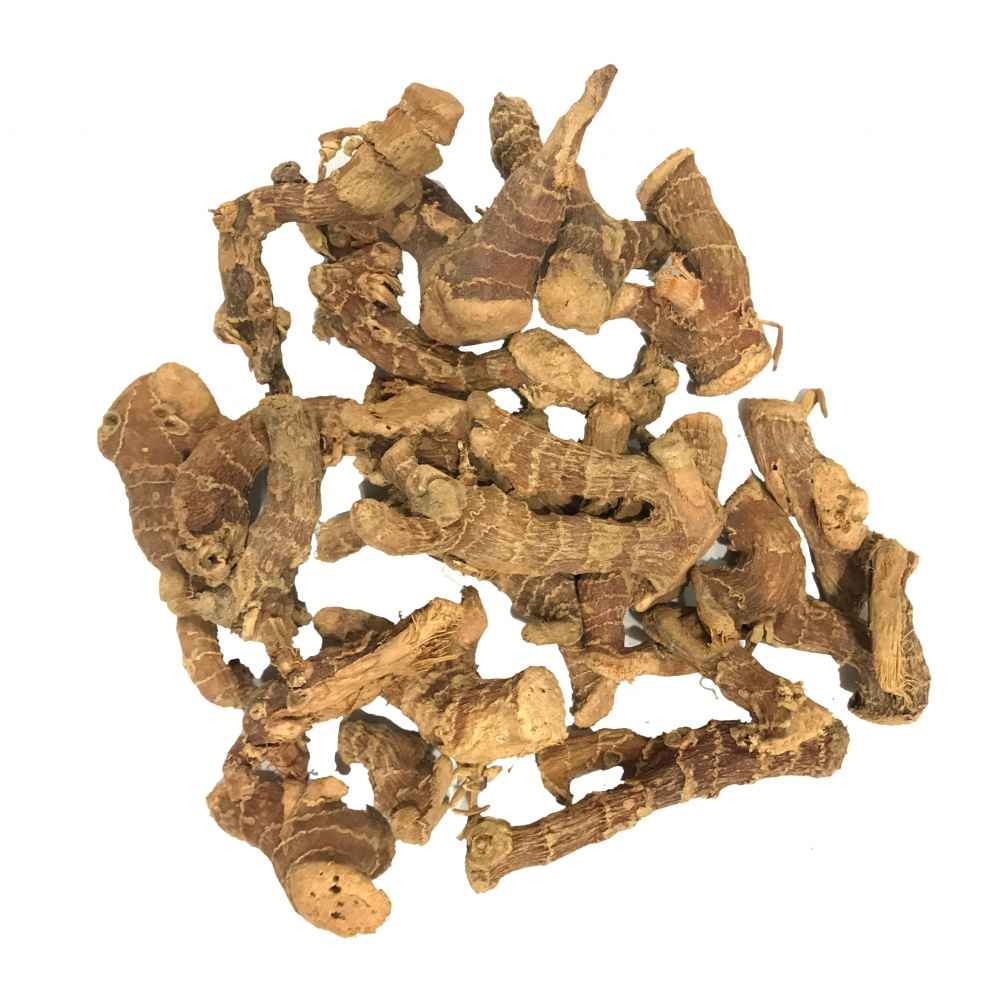
Galangal (Kulanjan)
Alpinia galanga (L.) Willd.
Bulk galangal rhizome (Alpinia galanga) in whole, sliced, cut and powder grades for spice houses, Ayurvedic, Unani and extract manufacturers sourcing from India.
- Botanical nameAlpinia galanga (L.) Willd.
- Part usedDried rhizome
- FamilyZingiberaceae
- Also known asKulanjan, Kolinjan, Rasna, Perarattai, Dhumrapatra, Sugandhamula, Pei-Kua, Laos, Lengkuas
- Certificate of Analysis
- Samples available
- Export documents handled
Galangal is the dried rhizome of Alpinia galanga (L.) Willd., known in India as Kulanjan. It is a pungent, aromatic member of the ginger family bought by spice blenders, Ayurvedic and Unani units, extract houses and flavour companies.
Botanical identity and part used
Galangal belongs to the Zingiberaceae family, alongside ginger and turmeric. The traded article is the dried rhizome, cut into slices or chips before drying.
Two species share the English name and they are not interchangeable. Greater galangal is Alpinia galanga and is the larger, paler, milder rhizome used in Southeast Asian cooking. Lesser galangal is Alpinia officinarum Hance, a smaller, darker, sharper rhizome traded more in Chinese and Unani contexts. Always confirm the species on the specification, because substitution between the two is common in loose trade.
Where it grows in India
Galangal is cultivated in the humid coastal and hill tracts of India. Kerala, Tamil Nadu and Karnataka in the south, and parts of West Bengal, Assam and the North East, carry most of the crop.
It grows in warm, well-drained loam under partial shade, and is also collected from wild and semi-wild stands. Rhizomes are lifted after roughly one growing season and are at their most aromatic when mature.
Harvest and processing
Rhizomes are dug, washed free of soil, and trimmed of roots and aerial stem bases. They are then sliced across the rhizome into chips and sun or shade dried.
Slicing before drying matters, because whole undried galangal is fibrous and dries unevenly. Milling is normally done on impact or pin mills and the fibre content makes fine mesh harder to achieve than with turmeric or ginger.
What the trade is buying
Galangal's value sits in its volatile oil, which drives both the aroma and the extract yield. Steam-distilled oil is dominated by 1,8-cineole, with alpha-pinene, fenchyl acetate, limonene and terpinen-4-ol also reported in Indian material.
The pungent principle is 1'-acetoxychavicol acetate, often shortened to ACA or galangal acetate. It is the compound most research interest is directed at, and extract buyers usually specify against it rather than against volatile oil alone.
Quality pitfalls buyers should check
The main commercial risks are species substitution, excessive fibre and root material in the cut, and field sand raising acid-insoluble ash. Aged rhizome loses volatile oil steadily, so a lot that passes on appearance can still be flat on aroma.
Forms that trade
AV Biotech supplies whole dried rhizome, sliced chips, cut and sifted material, and milled galangal powder, with extract-feedstock grades quoted separately.
Industry applications of galangal
Galangal reaches four main buyer groups. The cut you need follows from whether the material is being infused, milled into a blend, or extracted.
Spice blending and food manufacturing
Spice houses use galangal powder and cut rhizome in Thai and Indonesian curry pastes, tom yum and tom kha bases, rendang and laksa mixes. It is also used in Middle Eastern and North African spice blends.
Blenders specify mesh and colour tightly, since galangal is paler than ginger and a dull lot shows up in a finished paste. Cut and sifted material goes into wet paste lines where the grinder does the final reduction.
Ayurvedic and Unani manufacturing
Kulanjan is used in Ayurvedic and Unani preparations in churna, kwath and taila formats. It appears in traditional digestive and respiratory-positioned formulations, and in Unani practice under the name Khulanjan.
One naming caution matters here. Galangal is sometimes traded as Rasna, a name that properly belongs to Pluchea lanceolata and Alpinia species depending on region. Confirm the botanical name if your formulation file names Rasna.
Extract, flavour and fragrance
Extract houses take sliced or cut rhizome as feedstock for steam-distilled essential oil, CO2 extracts and solvent oleoresins. These buyers specify volatile oil content and, increasingly, ACA level.
Flavour and fragrance houses use galangal oil in spice accords, in bitters and in premium beverage formulations.
Beverage, bitters and functional products
Distillers use galangal in gin botanical blends, amari and herbal bitters. Functional beverage brands use it in digestive tonics and ginger-family blends where a sharper, more camphoraceous note is wanted.
Common product formats
- Thai and Indonesian curry paste and soup bases
- Dry spice blends and marinades
- Ayurvedic churna, kwath and Unani safoof preparations
- Steam-distilled galangal essential oil and CO2 extracts
- Standardised extracts specified on ACA content
- Gin botanicals, bitters and amaro formulations
- Digestive and respiratory-positioned supplement blends
- Herbal tea and infusion cuts
Traditional use and current research
Galangal has parallel records in Ayurveda, Unani practice, traditional Chinese medicine and Southeast Asian food culture. Most of it centres on digestion and on the warming, pungent character of the rhizome.
Traditional positioning
Traditionally used in Ayurveda as Kulanjan, described as pungent and warming and used in preparations aimed at digestive fire and at respiratory comfort. Unani practice uses Khulanjan in similar warming formulations.
In Southeast Asian food tradition, galangal is a culinary staple rather than a medicinal herb, and the two roles overlap in most household use.
Digestive comfort
Like other Zingiberaceae rhizomes, galangal is traditionally taken after meals to support digestive comfort. Brands commonly formulate it into products targeting post-meal ease and appetite.
Research on the pungent principle
Most published work focuses on 1'-acetoxychavicol acetate. Laboratory studies suggest antimicrobial activity against gram-positive bacteria, yeasts and some dermatophytes, and reviews have discussed anti-inflammatory and antioxidant properties in cell and animal models.
This work is preclinical. Human clinical evidence for galangal is limited compared with ginger or turmeric, and product positioning should reflect that gap honestly.
Respiratory and general tonic use
Traditional systems use galangal in preparations intended to support clear breathing and throat comfort. It is commonly formulated into lozenges, warming teas and seasonal wellness blends.
Aroma and sensory role
For many buyers the purchase is sensory rather than functional. The 1,8-cineole led profile gives a camphoraceous, pine-citrus lift that ginger does not provide, which is why it is not substitutable in an authentic Thai or Indonesian base.
Points buyers should note
Species matters for any claim. Alpinia galanga and Alpinia officinarum have different constituent profiles, and a study on one does not substantiate a claim on the other. Build claim files on the same species and preparation used in the cited work.
This information is provided for educational and B2B product-sourcing purposes only. It is not medical advice and these statements have not been evaluated by any regulatory authority. Finished-product claims are the responsibility of the manufacturer.
| Botanical name | Alpinia galanga (L.) Willd., Fam. Zingiberaceae (greater galangal; distinct from Alpinia officinarum Hance) |
|---|---|
| Part used | Dried rhizome, sliced or cut before drying |
| Appearance | Pale buff to light reddish-brown slices with concentric rings and a fibrous fracture; powder cream to light tan. Aroma camphoraceous and pine-like, taste pungent and slightly bitter |
| Active constituents with typical assay | Volatile oil typically 0.5 to 1.5 per cent on dried rhizome, with 1,8-cineole the dominant constituent alongside alpha-pinene, fenchyl acetate and terpinen-4-ol. Pungent principle 1'-acetoxychavicol acetate (ACA); extracts standardised to a buyer-agreed ACA level by HPLC. Values are indicative and vary with origin and maturity |
| Moisture | Not more than 10 per cent (typical trade limit for dried rhizome and powder) |
| Total ash | Not more than 7 per cent (typical) |
| Acid-insoluble ash | Not more than 1.5 per cent (typical); higher values usually indicate field sand from drying yards |
| Foreign matter | Not more than 2 per cent; adhering roots, stem bases and other Alpinia species specified separately |
| Particle size | Whole and sliced chips as dried; cut and sifted 2 to 8 mm; tea cut 0.5 to 2 mm; powder 40, 60 and 80 mesh. Fibre content makes 100 mesh and finer harder to achieve than with ginger or turmeric |
| Pesticide / heavy-metal / microbial testing | Pesticide residues tested against EU MRL or a buyer-nominated panel. Heavy metals: lead NMT 10 ppm, arsenic NMT 3 ppm, cadmium NMT 0.3 ppm, mercury NMT 1 ppm to AYUSH limits. Microbiology: total plate count, yeast and mould, E. coli and Salmonella to agreed limits. Aflatoxin B1 and total aflatoxin screening on request. Steam sterilisation available for spice-grade lots |
| Packing | 25 kg HDPE or PP laminated bags with food-grade LDPE inner liner; 40 to 50 kg bags for whole and sliced rhizome; fibre drums for powder and extract-grade material |
| Shelf life | 24 months for whole and sliced rhizome, 12 to 18 months for powder, in sealed original packing under cool dry storage |
Values are typical and indicative. A lot-specific Certificate of Analysis is shared before dispatch.
What is your minimum order quantity for galangal?
100 kg for powder and cut grades, and 500 kg for whole or sliced rhizome. Samples of 250 g to 1 kg are supplied so your team can assess aroma and confirm volatile oil before ordering. Part-container and full-container consolidation are both possible from Jaipur.
Do you supply greater galangal or lesser galangal?
Our standard offering is greater galangal, Alpinia galanga. Lesser galangal, Alpinia officinarum, is a different species with a smaller, darker, sharper rhizome and a different constituent profile. Substitution between the two is common in loose trade, so we confirm the species on the Certificate of Analysis.
Can you supply to a specified volatile oil or ACA level?
We select lots against an agreed volatile oil range and share the pre-shipment result before dispatch. For 1'-acetoxychavicol acetate we work with extract-grade material and standardise against a buyer-agreed HPLC figure. Tell us the method your specification names, since ACA results vary between methods.
What quality problems should I check for in a galangal lot?
Check three things. Species identity, because lesser galangal and other Alpinia species appear in mixed lots. Fibre and adhering root content in the cut, which dilutes aroma while looking acceptable. And acid-insoluble ash, since field sand from open drying yards is the usual cause of high figures.
What is the lead time, and can you mill or sterilise to our requirement?
7 to 12 working days for stock grades from Jaipur, and 3 to 4 weeks for organic lots, custom milling or steam-sterilised material. We mill to 40, 60 and 80 mesh and cut to 0.5 to 8 mm. Very fine meshes are harder to hold on galangal than on ginger because of the fibre, so discuss the target before you fix a specification.
Enquire about Galangal (Kulanjan)
No payment is taken here — this reaches our sourcing team directly.
Related products