Haritaki
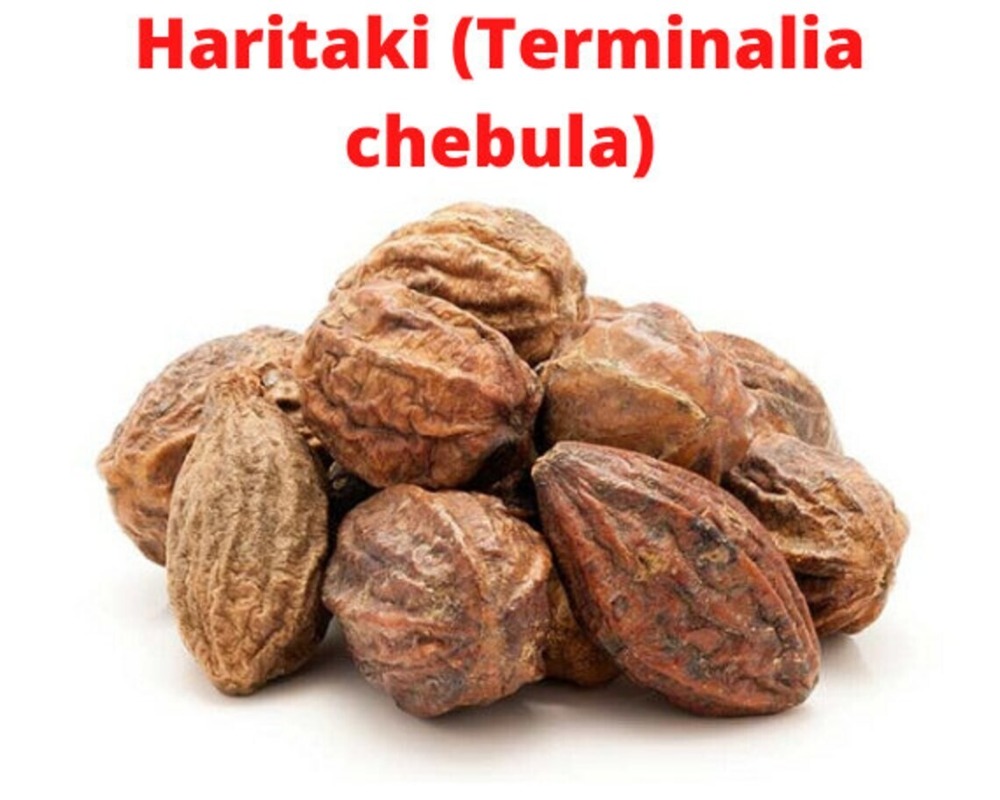
Haritaki
Terminalia chebula Retz.
Dried fruit of Terminalia chebula, the tannin-rich Triphala herb sourced in bulk by Ayurvedic, nutraceutical, cosmetic and extraction units.
- Botanical nameTerminalia chebula Retz.
- Part usedDried fruit pericarp (rind); whole dried fruit also traded
- FamilyCombretaceae
- Also known asHarad, Harre, Harar, Hirda, Halela, Kadukkai, Karakkaya, Katukka, Alalekai, Harida
- Certificate of Analysis
- Samples available
- Export documents handled
Haritaki is the dried fruit of Terminalia chebula Retz., a tree of the Combretaceae family. It is the highest-volume myrobalan traded in India. AV Biotech supplies it as whole fruit, deseeded pericarp, cut and sifted, and milled powder.
Botanical identity and growing regions
The commercial drug is the pericarp, meaning the fibrous rind around the stone. The Ayurvedic Pharmacopoeia of India defines Haritaki as the pericarp of mature fruits of Terminalia chebula. Intact fruits are yellowish-brown and ovoid, 20 to 35 mm long and 13 to 25 mm wide.
The rind is 3 to 4 mm thick and does not adhere to the seed. Longitudinal ribs and wrinkles are clearly visible on a genuine lot. Taste is sharply astringent, which is the first field check most buyers use.
The tree grows across India in dry deciduous forest up to about 1,500 m elevation. Commercial collection centres on Madhya Pradesh, Chhattisgarh, Maharashtra, Jharkhand, Odisha and Karnataka. Flowering runs April to August and fruits ripen between October and January.
Harvest and processing
Fruits are hand-collected after natural drop or picked at full maturity. They are sun-dried until the rind hardens and moisture falls below about 10 per cent. Poorly dried lots darken, and mould risk rises sharply in transit.
Deseeding is done by hand or by mechanical crackers. The stone accounts for roughly a third of whole-fruit weight. Deseeded rind therefore costs more per kilo but delivers far more usable material to an extraction plant.
Grades that trade
Bada harad, also called pili or big yellow, is fully mature fruit. Choti harad, also called kali harad, is the small immature black fruit and usually assays higher in tannin. Harad chilka is the deseeded rind, and Kabuli harad is the large pale grade favoured for confectionery-style preparations.
Buyers should state which grade they need. The same botanical name covers material with very different tannin levels and very different price points.
Why buyers source it
Haritaki is one of the three fruits in Triphala, alongside Bibhitaki and Amla. That single formulation absorbs a large share of Indian demand. Beyond Triphala, the fruit is valued as a natural source of hydrolysable tannins for extraction.
Reported tannin content in the pericarp typically ranges from 25 to 40 per cent, with chebulinic acid, chebulagic acid, corilagin, gallic acid and ellagic acid as the main markers. Extract makers work to a declared tannin or chebulinic acid assay rather than to appearance alone.
Forms in regular trade are whole fruit, deseeded pericarp, cut and sifted, powder at 40 to 100 mesh, and standardised extracts.
Industrial applications of Haritaki
Haritaki moves into five distinct buyer segments. Each segment wants a different grade, so specifying the end use up front avoids re-sampling.
Ayurvedic and pharmaceutical manufacturing
This is the largest outlet by volume. Deseeded pericarp and 60 to 80 mesh powder feed churna, tablet, capsule and kwath production. Triphala churna alone accounts for a substantial share of orders.
Manufacturers working to Ayurvedic Pharmacopoeia of India standards usually specify extractive values as well as ash limits. Pericarp-only material passes those tests far more reliably than whole crushed fruit.
Nutraceutical and supplement brands
Supplement brands buy standardised extracts, often declared on tannins or on chebulinic acid by HPLC. Powder at 80 mesh is used for capsule filling and blended digestive formulas. Export buyers generally require a batch certificate of analysis before shipment.
Cosmetic and personal care
Tannin-rich fruit powder is used in hair and scalp preparations, herbal hair colours and face packs. Formulators also use aqueous extracts for astringent toners. Fine milling at 100 mesh matters here, because grit is visible in a finished cream.
Extraction and natural tannin industry
Extractors buy on assay, not on looks. Small black immature fruit is often preferred because tannin concentration is higher. Leather and natural dye units also use myrobalan tannin, though usually at lower purity grades.
Veterinary and agri-input
Coarse powder is used in cattle feed premixes and poultry gut-health blends. Some organic farm-input makers use it in botanical spray formulations.
Common product formats we supply into
- Triphala churna and single-herb Haritaki churna
- Tablets, capsules and softgel blends
- Kwath, kadha and decoction concentrates
- Herbal hair colour, hair oil and scalp packs
- Face packs, ubtan and astringent toners
- Standardised tannin and chebulinic acid extracts
- Herbal tooth powder and mouth rinse bases
- Digestive tonics, syrups and avaleha
- Livestock feed premixes and poultry supplements
- Natural dye and vegetable tanning inputs
Traditional uses and research context
Haritaki has one of the longest documented histories of any Indian botanical. Classical Ayurvedic texts describe it as a rasayana, a category of rejuvenative herbs. It is best known as a component of Triphala.
Digestive and elimination support
Haritaki is traditionally used in Ayurveda to support regular bowel movement and digestive comfort. The Ayurvedic Pharmacopoeia of India lists anulomana, meaning downward movement, among its actions. Products targeting occasional constipation and digestive balance are the most common commercial application.
Antioxidant and free-radical activity
The fruit is unusually rich in hydrolysable tannins and polyphenols. Studies suggest that chebulinic acid, chebulagic acid, corilagin and gallic acid contribute measurable antioxidant activity in laboratory models. Brands commonly formulate it into products positioned around antioxidant support.
Oral care applications
The astringent character of the fruit has long been used in traditional tooth powders and gargles. Research on tannin-rich extracts suggests activity against common oral bacteria in vitro. This underpins its use in herbal dental and mouth-rinse formats.
Metabolic and general wellness formulas
Traditionally used in Ayurveda as a general tonic, Haritaki appears in many multi-herb wellness blends. Preliminary studies have explored effects on lipid and glucose parameters, though evidence in humans remains limited. Formulators typically position such products around metabolic wellness rather than any specific outcome.
Skin and hair traditions
External preparations using Haritaki are traditionally applied in hair and scalp care. The tannin fraction gives natural colour depth, which is why it appears in herbal hair colour blends alongside indigo and henna.
A note on dosage and formulation
The Ayurvedic Pharmacopoeia of India gives a traditional dose of 3 to 6 g of powder. Finished-product dosing, label claims and safety assessment remain the manufacturer's responsibility. Buyers formulating for export markets should check permitted claims in the destination country before finalising labels.
This information is provided for educational and B2B product-sourcing purposes only. It is not medical advice and these statements have not been evaluated by any regulatory authority. Finished-product claims are the responsibility of the manufacturer.
| Botanical name | Terminalia chebula Retz. (Combretaceae) |
|---|---|
| Part used | Dried fruit pericarp; whole fruit on request |
| Appearance | Whole: yellowish-brown ovoid fruit, 20-35 mm long, longitudinally ribbed. Powder: light to medium brown, free-flowing |
| Odour and taste | Faint characteristic odour; markedly astringent taste |
| Active constituents (typical assay) | Hydrolysable tannins 25-40%; markers include chebulinic acid, chebulagic acid, corilagin, gallic acid and ellagic acid. Extracts commonly standardised to 40% tannins or a declared chebulinic acid figure by HPLC |
| Moisture / loss on drying | Not more than 10% (typical 6-9%) |
| Total ash | Not more than 5% (API limit for Haritaki) |
| Acid-insoluble ash | Not more than 5% (API limit); good lots run well below 1% |
| Foreign matter | Not more than 1% (API limit) |
| Alcohol-soluble extractive | Not less than 40% (API limit) |
| Water-soluble extractive | Not less than 60% (API limit) |
| Particle size | Powder 40, 60, 80 or 100 mesh BSS to order; cut and sifted 2-8 mm; whole fruit ungraded or size-sorted |
| Heavy metals | Lead NMT 10 ppm, Arsenic NMT 3 ppm, Cadmium NMT 0.3 ppm, Mercury NMT 1 ppm (API / WHO basis, by ICP-MS) |
| Pesticide residues | Tested to API appendix; EU MRL screen (Reg. 396/2005) available on request |
| Aflatoxins | B1 not more than 5 ppb, total not more than 10 ppb (EU herbal-material basis) |
| Microbiology | Total plate count NMT 10^5 cfu/g; yeast and mould NMT 10^3 cfu/g; E. coli, Salmonella, S. aureus and P. aeruginosa absent |
| Packing | 25 kg paper-laminated or HDPE bags with food-grade LDPE liner; 20-25 kg fibre drums; 500-800 kg jumbo bags for whole fruit |
| Shelf life | 36 months for whole and cut; 24 months for powder, in original sealed packing |
Values are typical and indicative. A lot-specific Certificate of Analysis is shared before dispatch.
What is the minimum order quantity for Haritaki powder?
Our standard MOQ is 100 kg per grade for powder and cut & sifted material, and 500 kg for whole fruit. Standardised extracts start at 25 kg. For first orders we can supply a 100 to 500 g evaluation sample so your QC team can verify mesh, colour and assay before you commit.
Should I buy whole fruit or deseeded pericarp?
Deseeded pericarp if you are milling or extracting, because the stone is roughly a third of whole-fruit weight and contributes nothing to your yield. Whole fruit works if you are re-selling, or if your own plant has deseeding capacity. Deseeded material carries a higher per-kilo price but a lower effective cost per kilo of usable rind.
What documentation is supplied with each consignment?
Every despatch carries a batch-specific certificate of analysis covering moisture, ash values, extractives, heavy metals, pesticide screen and microbiology from a NABL-accredited laboratory. Export consignments also include a phytosanitary certificate, certificate of origin, packing list and commercial invoice. Organic transaction certificates are issued where the lot is certified.
Can you match a specific tannin assay?
Yes, within the natural range of the crop. Small black immature fruit generally assays higher in tannins than large mature fruit, so we select the grade against your target. Share your assay method, because a titrimetric total-tannin figure and an HPLC chebulinic acid figure are not interchangeable numbers.
What is the typical lead time for a bulk order?
Seven to twelve working days for cleaning, milling, testing and packing on standard grades held in stock. Custom mesh, organic-certified lots or fresh-crop material can take three to four weeks. Fruits are collected between October and January, so the widest grade selection is available from November onward.
Enquire about Haritaki
No payment is taken here — this reaches our sourcing team directly.
Related products