Guava (Amrud)
Guava (Amrud)
Psidium guajava L.
Bulk guava leaf (Psidium guajava) in cut, sifted and powder grades for tea, nutraceutical, extract and cosmetic manufacturers sourcing from India.
- Botanical namePsidium guajava L.
- Part usedLeaf (primary trade grade); bark and dried fruit traded separately
- FamilyMyrtaceae
- Also known asAmrud, Amrood, Jamphal, Peru, Koyya, Jama, Perakka, Sebu, Bihi, Amrut Phal
- Certificate of Analysis
- Samples available
- Export documents handled
Guava leaf is the dried foliage of Psidium guajava L., a Myrtaceae tree grown across India as a fruit crop. The leaf, not the fruit, is what moves in the herbal raw-material trade.
Why the leaf is the traded part
Guava fruit is a fresh produce and pulp commodity. The herbal market buys the leaf, which is rich in polyphenols and flavonol glycosides and is the basis for guava leaf tea and standardised extracts.
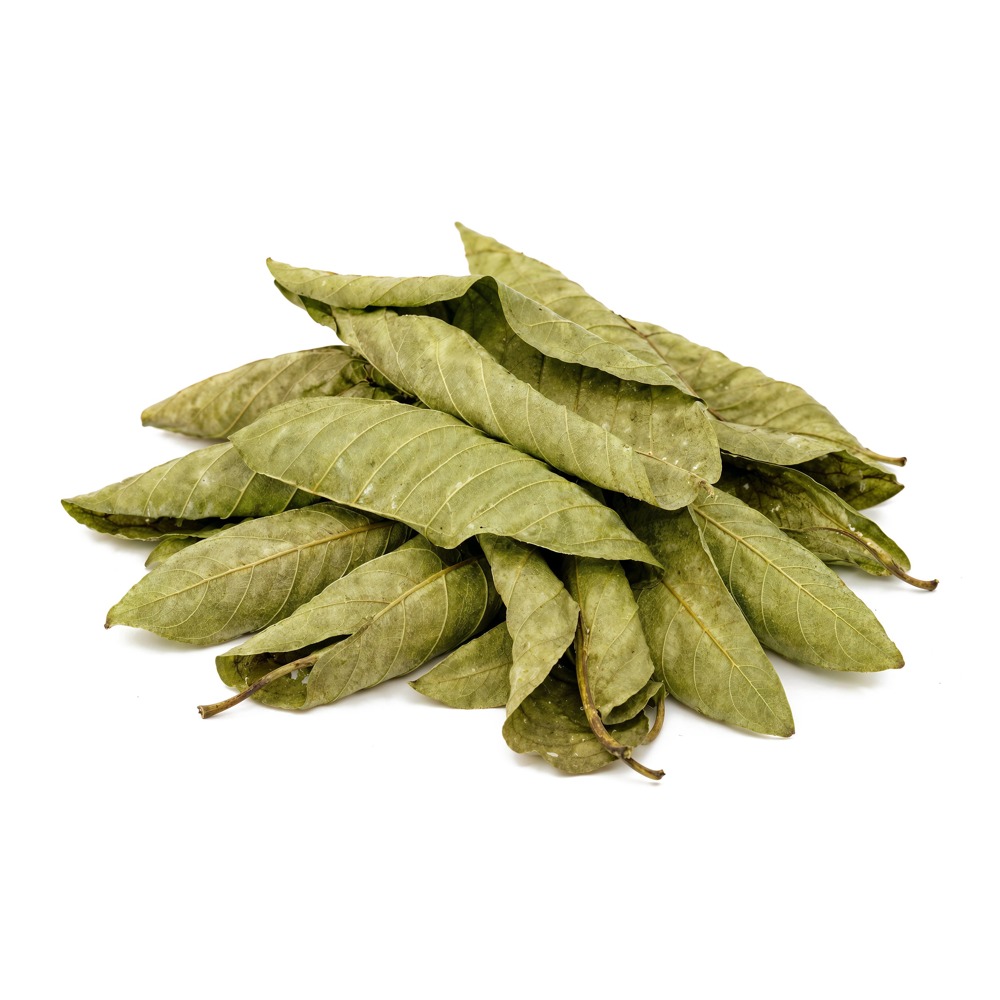
Leaves are opposite, oblong to elliptic, 5 to 15 cm long, with prominent pinnate veins visible on the underside. The underside is finely hairy and duller than the upper surface. Crushed fresh leaf gives a distinct aromatic, slightly astringent note.
Where it comes from in India
India is among the largest guava producers in the world. Uttar Pradesh, Madhya Pradesh, Bihar, Maharashtra, Andhra Pradesh, Chhattisgarh and Punjab carry the main orchard acreage.
Leaf supply is largely a by-product of orchard pruning. That has a practical consequence for buyers: leaf availability peaks with the orchard pruning calendar rather than with a dedicated herb harvest.
Harvest, drying and grading
Mature green leaves are stripped from pruned branches and shade dried. Sun drying browns the leaf quickly and destroys the green that tea buyers want. Low-temperature tray drying gives the most consistent colour.
Dried leaf is destemmed, sifted to remove twig and petiole, and either supplied as cut leaf or milled. Twig content is the quality parameter buyers most often overlook, and it directly raises crude fibre and dilutes polyphenol assay.
What buyers assay
The leaf carries quercetin and its glycosides including quercitrin, isoquercitrin, guaijaverin, avicularin and hyperoside, along with ellagic acid, gallic acid and condensed tannins. Reported total phenolic values in leaf extracts run high, and published work records quercetin levels up to around 9.9 per cent w/w in validated extracts.
Raw leaf powder assays far below extract levels. Buyers usually declare either total polyphenols as gallic acid equivalent or quercetin by HPLC, and the two figures are not interchangeable.
Forms that trade
AV Biotech supplies guava leaf as whole dried leaf, cut and sifted tea-cut, and milled powder, plus extract-grade destemmed leaf. Organic-certified lots are available against advance contract, which matters here because orchards are routinely sprayed.
Industry applications of guava leaf
Guava leaf sells into four main streams. The grade differences between them are significant, so the end use should be declared at enquiry.
Herbal tea and functional beverage
This is the largest volume outlet, driven strongly by Japan, Korea, Taiwan and Southeast Asian markets where guava leaf tea is an established category. Buyers want a clean tea-cut, typically 2 to 5 mm, with low dust and a bright green to olive colour.
Twig and petiole content is the main rejection reason. Tea-bag fillers also specify a narrow particle band so the cut does not sift through the paper.
Nutraceutical and extract manufacturing
Extract houses buy destemmed leaf as feedstock and standardise on total polyphenols or on quercetin by HPLC. Finished extracts go into capsules, tablets and blood-sugar-support positioned blends.
Extractors negotiate on leaf maturity as well as assay. Over-mature, yellowing leaf carries lower polyphenol content and higher ash.
Cosmetic and personal care
Guava leaf extract is used in oil-control serums, scalp tonics, acne-positioned cleansers and astringent toners. The tannin fraction gives the astringent feel that formulators want. Fine milling at 100 mesh is needed for masks and scrubs.
Ayurvedic, Unani and veterinary use
Traditional manufacturers use leaf powder and decoction bases in digestive and oral-care preparations. Coarse powder also goes into poultry and livestock gut-health premixes.
Common product formats
- Single-herb guava leaf tea and tea-bag blends
- Ready-to-drink functional beverages and iced infusions
- Capsules and tablets positioned around metabolic wellness
- Standardised polyphenol and quercetin extracts
- Herbal mouth rinse and tooth powder bases
- Oil-control toners, acne-positioned cleansers and scalp tonics
- Poultry and livestock gut-health premixes
Traditional use and research context
Guava leaf has a long record in Indian folk practice, Unani medicine and across Latin America and Southeast Asia. It is traditionally prepared as a decoction or infusion.
Blood-sugar and metabolic positioning
This is the most researched area. Studies suggest that aqueous guava leaf extract influences glucose handling in animal models, with published work examining hepatic glycogen synthesis, intestinal glucose transport and insulin sensitivity markers.
Guava leaf tea is an approved functional food category in Japan on this basis. Brands elsewhere commonly formulate it into products positioned around metabolic wellness rather than any disease outcome.
Digestive comfort traditions
Traditionally used across Asia and Latin America as a decoction for occasional loose motions and digestive upset. The tannin and flavonoid fraction is usually credited with the astringent action described in traditional texts.
Antioxidant activity
The leaf is unusually rich in polyphenols. Studies suggest strong radical-scavenging activity in laboratory assays, with quercetin, quercitrin, ellagic acid and gallic acid among the contributing markers.
Oral care applications
Guava leaf chewing is a traditional oral hygiene practice in several Indian regions. Research on leaf extracts suggests activity against common oral bacteria in vitro, which underpins its use in herbal tooth powders and rinses.
Skin and scalp positioning
Formulators use the extract in products targeting oily skin, blemish-prone skin and scalp comfort. Positioning is cosmetic, based on the astringent and antioxidant character of the tannin fraction.
Notes buyers should carry into claims
Almost all published work uses an aqueous or hydro-alcoholic extract at a defined dose, not plain leaf powder. Substantiation should be built on the same material form and assay basis as the study you cite.
Guava leaf products are regulated differently across markets. Check whether your destination treats guava leaf tea as a food, a supplement or a notified botanical before finalising labels.
This information is provided for educational and B2B product-sourcing purposes only. It is not medical advice and these statements have not been evaluated by any regulatory authority. Finished-product claims are the responsibility of the manufacturer.
| Botanical name | Psidium guajava L., Fam. Myrtaceae |
|---|---|
| Part used | Dried mature leaf, destemmed; bark and dried fruit quoted separately |
| Appearance | Cut leaf: green to olive-green flakes with visible pinnate venation. Powder: green to greenish-brown, free-flowing |
| Odour and taste | Characteristic aromatic odour; taste astringent and slightly bitter |
| Active constituents (typical assay) | Flavonol glycosides and polyphenols - quercetin, quercitrin, isoquercitrin, guaijaverin, avicularin, hyperoside, plus ellagic acid, gallic acid and condensed tannins. Raw leaf powder assays far below extract levels. Extracts commonly declared on total polyphenols as gallic acid equivalent, or on quercetin by HPLC, with validated extracts reported up to around 9.9 per cent w/w quercetin |
| Moisture / loss on drying | Not more than 10 per cent (typical 6 to 9 per cent) |
| Total ash | Not more than 10 per cent (indicative trade limit) |
| Acid-insoluble ash | Not more than 2 per cent (indicative) |
| Foreign matter | Not more than 2 per cent; stem and petiole content declared separately and kept under 5 per cent on tea-cut grade |
| Particle size | Tea-cut 2 to 5 mm; cut and sifted 5 to 10 mm; powder at 40, 60, 80 or 100 mesh BSS |
| Heavy metals | Lead NMT 10 ppm, Arsenic NMT 3 ppm, Cadmium NMT 0.3 ppm, Mercury NMT 1 ppm (AYUSH basis, by ICP-MS) |
| Pesticide residues | Multi-residue screen against EU MRL (Reg. 396/2005). Important on this material, since leaf is usually a by-product of sprayed fruit orchards. Organic lots screened as standard |
| Microbiology | Total plate count NMT 10^5 cfu/g; yeast and mould NMT 10^3 cfu/g; E. coli, Salmonella, S. aureus and P. aeruginosa absent. Steam-sterilised grade available for tea buyers |
| Aflatoxins | B1 not more than 5 ppb, total not more than 10 ppb (EU herbal-material basis) |
| Packing | 20 to 25 kg HDPE or paper-laminated bags with food-grade LDPE liner; fibre drums for low-density tea-cut |
| Shelf life | 24 months for cut leaf and powder in sealed original packing |
Values are typical and indicative. A lot-specific Certificate of Analysis is shared before dispatch.
What is your minimum order quantity for guava leaf?
100 kg per grade for tea-cut and powder, and 25 kg for standardised extracts. We supply 250 g to 1 kg evaluation samples so your team can check cut size, colour and brew character before a bulk commitment. Sample freight is at the buyer's account.
How do you control pesticide residues on guava leaf?
This is the key risk on this material, because leaf usually comes from pruning in commercial fruit orchards that are sprayed for fruit fly and fungal disease. We screen on a multi-residue panel against EU MRL and can source from certified organic orchards where your limits are tight. Share your residue specification at enquiry stage.
Can you supply a low-stem tea-cut for tea bags?
Yes. Our tea-cut grade is destemmed and sifted to a 2 to 5 mm band with stem and petiole content kept under 5 per cent and dust removed. Tell us your tea-bag paper spec and we will match the particle band so fines do not sift through.
What documentation ships with an export consignment?
A batch-specific certificate of analysis covering moisture, ash, foreign matter, heavy metals, pesticide screen and microbiology from a NABL-accredited laboratory. Export shipments also carry a phytosanitary certificate, certificate of origin, packing list and commercial invoice, plus an organic transaction certificate where the lot is certified.
What is the lead time and when is supply best?
Seven to twelve working days for stock grades, and three to four weeks for organic lots, steam-sterilised material or custom cut sizes. Leaf availability follows the orchard pruning calendar rather than a dedicated herb harvest, so large tea-cut programmes are best contracted in advance.
Enquire about Guava (Amrud)
No payment is taken here — this reaches our sourcing team directly.
Related products