Tulsi (Holy Basil)
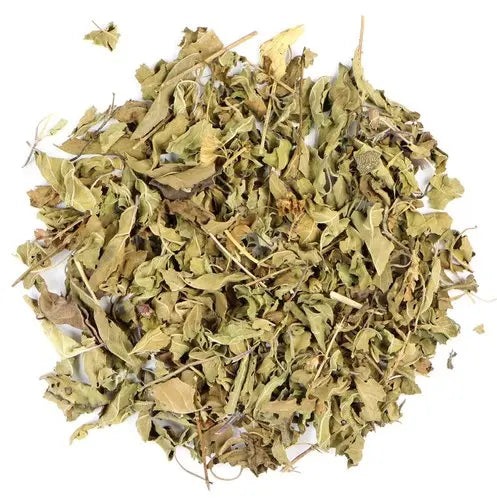
Tulsi (Holy Basil)
Ocimum tenuiflorum L. (syn. Ocimum sanctum L.)
Dried holy basil leaf (Ocimum tenuiflorum), rich in eugenol and ursolic acid, supplied in bulk to Ayurvedic, herbal tea, supplement and cosmetic makers.
- Botanical nameOcimum tenuiflorum L. (syn. Ocimum sanctum L.)
- Part usedDried leaf; whole herb and seed traded separately
- FamilyLamiaceae
- Also known asTulasi, Surasa, Krishna Tulsi, Rama Tulsi, Vana Tulsi, Thulasi, Tulas, Raihan, Sacred Basil
- Certificate of Analysis
- Samples available
- Export documents handled
Tulsi is the dried leaf of Ocimum tenuiflorum L., listed in older references as Ocimum sanctum L. It belongs to the Lamiaceae or mint family. AV Biotech supplies whole dried leaf, tea-bag cut, cut and sifted, powder and extract.
Getting the species right
Three plants are sold in India as Tulsi and they are not the same material. Rama or Sri Tulsi is the green-leaved form of Ocimum tenuiflorum. Krishna or Shyama Tulsi is the purple-leaved form of the same species.
Vana Tulsi is a different species, Ocimum gratissimum, with its own oil profile. Sweet basil, Ocimum basilicum, is a fourth species entirely and is not holy basil, though the two are sometimes confused in loose trade descriptions.
State the type you want on the purchase order. The choice changes both the eugenol level and the ursolic acid assay you can expect.
Leaf versus whole herb
The Ayurvedic Pharmacopoeia of India carries separate monographs for Tulasi leaf and Tulasi whole plant, with different limits. Leaf allows total ash up to 19 per cent and acid-insoluble ash up to 3 per cent. Whole plant allows total ash up to 10 per cent and acid-insoluble ash up to 1.5 per cent.
Buyers regularly test leaf material against whole-plant limits and reject sound lots. Confirm which monograph your specification refers to before setting acceptance criteria.
Cultivation, harvest and drying
Tulsi is cultivated rather than wild-collected in most commercial supply. Growing areas include Madhya Pradesh, Uttar Pradesh, Rajasthan, Uttarakhand and Chhattisgarh. It is an annual crop that supports two to four cuttings in a season.
Leaves are harvested at or just before flowering, when volatile oil content peaks. Drying method decides the grade. Shade drying or controlled low-temperature drying holds the green colour and the oil, while open sun drying bleaches the leaf and drives off eugenol.
Leaf is then de-stemmed, sieved and either cut or milled. Stem content is the most common quality complaint in bulk Tulsi, because stems raise ash and dilute the oil.
Constituents buyers work with
Dried leaf typically yields between 0.4 and 0.8 per cent essential oil, with reported seasonal peaks above 1.5 per cent. Eugenol is usually the dominant oil component, commonly reported between 40 and 70 per cent, alongside methyl eugenol and beta-caryophyllene.
Ursolic acid is the marker most supplement brands specify. Published figures put green Rama-type leaf at roughly 0.35 to 0.48 per cent and purple Krishna-type leaf at roughly 0.25 per cent. Rosmarinic acid is also present and is increasingly requested.
Industrial applications of Tulsi
Tulsi sells into five segments, and the grade differences between them are larger than for most herbs. A tea packer and an extract plant want almost opposite material.
Herbal tea and beverage
This is the largest export outlet. Tea packers buy tea-bag cut leaf, generally 0.5 to 2 mm, screened for dust and stem. Colour retention matters as much as assay, so shade-dried leaf commands a premium.
Loose-leaf blends, ready-to-drink infusions and instant tea premixes also draw on the same grade. Steam-sterilised material is normal for this trade.
Ayurvedic and pharmaceutical manufacturing
Powder at 60 to 80 mesh feeds churna, tablet, capsule and kwath production. Tulsi appears in a large number of classical and proprietary respiratory and immunity formulations. Whole-herb material goes into decoction and swaras lines.
Nutraceutical and supplement brands
Export supplement brands buy extracts standardised on ursolic acid, commonly at 2 to 2.5 per cent, and increasingly on rosmarinic acid or total phenolics. Fine powder is used in capsules and in adaptogen blends. These buyers usually require identity confirmation to species, not just to the name Tulsi.
Cosmetic and personal care
Eugenol-bearing leaf and its extracts are used in face washes, anti-blemish creams, hair oils and scalp tonics. Tulsi essential oil is used in aroma and topical blends. Formulators buy powder at 100 mesh so finished textures stay smooth.
Food, veterinary and agri
Leaf powder is used in seasoning blends, herbal honey and functional food premixes. Coarse material moves into poultry and livestock gut-health premixes. Some botanical crop-input makers use Tulsi in spray formulations.
Common product formats we supply into
- Tulsi herbal tea, tea bags and loose-leaf blends
- Tulsi churna, tablets and capsules
- Kadha, kwath and immunity decoction premixes
- Cough syrups, drops and throat preparations
- Ursolic acid standardised extracts for supplements
- Face washes, anti-blemish creams and toners
- Hair oils, shampoos and scalp tonics
- Tulsi essential oil for aroma and topical use
- Herbal honey, seasoning and functional food premixes
- Poultry and livestock feed premixes
Traditional uses and research context
Tulsi occupies a place in Indian households that few herbs match, and it is well represented in the research literature. The Ayurvedic Pharmacopoeia of India lists actions including deepana, hridya and kaphahara for the leaf.
Respiratory and seasonal wellness
Tulsi leaf is traditionally used in Ayurveda in preparations for cough, cold and breathing comfort. Kasa and shvasa appear in its listed classical therapeutic uses. It is one of the most common ingredients in commercial kadha and immunity blends sold in India.
Adaptogenic and stress-response research
Tulsi is often described in the literature as an adaptogen, a term for plants studied for their effect on the body's stress response. A published systematic review of human studies reported favourable outcomes across a range of parameters, while noting that trial sizes and designs varied. Brands commonly formulate it into products positioned around stress balance and general resilience.
Antioxidant activity
Studies suggest that eugenol, ursolic acid, rosmarinic acid and the flavonoid fraction contribute antioxidant activity in laboratory assays. This underpins its use in antioxidant and general wellness supplement formats.
Oral care and skin traditions
The leaf has long been used in traditional oral rinses and tooth powders. Research on eugenol-bearing extracts suggests activity against common oral bacteria in vitro. In skin care, Tulsi is traditionally applied in preparations for blemish-prone skin, and cosmetic formulators use it on that basis.
Metabolic research interest
Several small human studies have examined Tulsi in relation to blood glucose and lipid parameters. Findings are encouraging but the evidence base remains limited. Formulators typically position such products around metabolic wellness rather than any defined clinical outcome.
Notes for formulators
The Ayurvedic Pharmacopoeia of India gives a traditional dose of 2 to 3 g of leaf powder. Eugenol and methyl eugenol are subject to concentration limits in some cosmetic and food regulations, so check destination-market rules for oil-bearing grades. Claims permitted for a herbal tea, a supplement and a cosmetic differ considerably even for the same botanical.
This information is provided for educational and B2B product-sourcing purposes only. It is not medical advice and these statements have not been evaluated by any regulatory authority. Finished-product claims are the responsibility of the manufacturer.
| Botanical name | Ocimum tenuiflorum L., syn. Ocimum sanctum L. (Lamiaceae) |
|---|---|
| Part used | Dried leaf; whole herb and seed supplied separately |
| Type | Rama / Sri Tulsi (green leaf) or Krishna / Shyama Tulsi (purple leaf), both Ocimum tenuiflorum. Vana Tulsi (Ocimum gratissimum) supplied on request as a separate item |
| Appearance | Leaves 2.5-5 cm long and 1.6-3.2 cm wide, elliptic-oblong. Dried leaf green to greyish-green; powder light green |
| Odour and taste | Strong characteristic aromatic odour; pungent and slightly bitter taste |
| Active constituents (typical assay) | Volatile oil 0.4-0.8% of dried leaf, with seasonal peaks reported above 1.5%; eugenol commonly 40-70% of the oil, with methyl eugenol and beta-caryophyllene. Ursolic acid approximately 0.35-0.48% in green Rama type and around 0.25% in purple Krishna type. Rosmarinic acid present. Extracts commonly standardised to 2-2.5% ursolic acid |
| Moisture / loss on drying | Not more than 10% (typical 6-9%) |
| Total ash | Not more than 19% for leaf (API leaf monograph); not more than 10% for whole plant (API whole-plant monograph) |
| Acid-insoluble ash | Not more than 3% for leaf; not more than 1.5% for whole plant |
| Foreign matter | Not more than 2% (API limit) |
| Alcohol-soluble extractive | Not less than 6% for leaf (API limit) |
| Water-soluble extractive | Not less than 13% for leaf (API limit) |
| Stem content | Leaf grade not more than 5%; declared per lot |
| Identity | TLC of the distilled oil against eugenol standard; eugenol band at approximately Rf 0.7 with vanillin-sulphuric acid reagent |
| Particle size | Whole leaf; tea-bag cut 0.5-2 mm; cut and sifted 2-6 mm; powder 60, 80 or 100 mesh BSS to order |
| Heavy metals | Lead NMT 10 ppm, Arsenic NMT 3 ppm, Cadmium NMT 0.3 ppm, Mercury NMT 1 ppm (API / WHO basis, by ICP-MS) |
| Pesticide residues | Tested to API appendix; EU MRL screen (Reg. 396/2005) available on request |
| Aflatoxins | B1 not more than 5 ppb, total not more than 10 ppb (EU herbal-material basis) |
| Microbiology | Total plate count NMT 10^5 cfu/g; yeast and mould NMT 10^3 cfu/g; E. coli, Salmonella, S. aureus and P. aeruginosa absent. Steam sterilisation available for tea and export grades |
| Packing | 20-25 kg paper-laminated or HDPE bags with food-grade LDPE liner; fibre drums for whole leaf, since leafy material is bulky and compresses poorly |
| Shelf life | 24 months for whole leaf and cuts; 18 months for powder, in original sealed packing |
Values are typical and indicative. A lot-specific Certificate of Analysis is shared before dispatch.
Which Tulsi type should I order, Rama or Krishna?
Rama or Sri Tulsi is the green-leaved type and generally assays higher in ursolic acid, around 0.35 to 0.48 per cent in published work. Krishna Tulsi is the purple-leaved type, usually around 0.25 per cent, and is often chosen for its darker liquor in teas. Vana Tulsi is a different species, Ocimum gratissimum, and must be ordered separately.
Why is your total ash figure higher than my specification allows?
Check which monograph your specification is based on. The Ayurvedic Pharmacopoeia of India allows total ash up to 19 per cent for Tulsi leaf, but only 10 per cent for Tulsi whole plant. Leaf material tested against whole-plant limits will fail even when it is sound. Acid-insoluble ash, limited to 3 per cent for leaf, is the parameter that actually reflects sand and soil.
Do you supply steam-sterilised material for tea packing?
Yes. Leafy material carries a naturally higher microbial load than roots and barks, so tea and export grades are normally steam-sterilised. We can also supply untreated material where your own process includes a kill step. Post-sterilisation microbial results are reported on the certificate of analysis.
How do you control stem content and leaf colour?
Leaf is de-stemmed and sieved after drying, and we hold leaf grade at not more than 5 per cent stem, declared per lot. Colour depends on drying, so tea grades are shade-dried or dried at controlled low temperature rather than in open sun. Sun-dried leaf looks pale and loses volatile oil.
Can you supply organic-certified Tulsi and matching documentation?
Yes. We work with certified organic cultivation blocks in Madhya Pradesh and Uttar Pradesh and can supply under NPOP, USDA NOP or EU organic scope. Each organic consignment ships with a transaction certificate alongside the certificate of analysis, packing list and phytosanitary certificate. Give us three to four weeks for organic lots so the paperwork travels with the goods.
Enquire about Tulsi (Holy Basil)
No payment is taken here — this reaches our sourcing team directly.
Related products