Black Cardamom (Badi Elaichi)
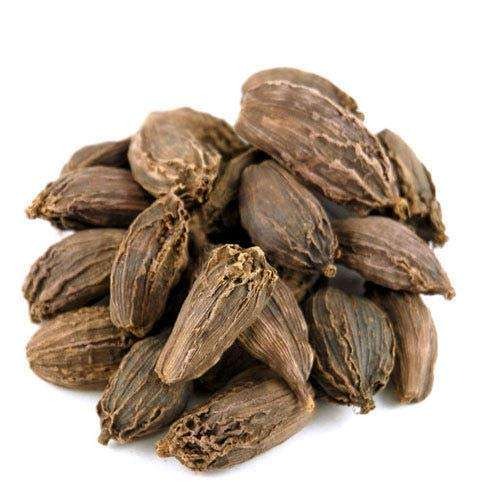
Black Cardamom (Badi Elaichi)
Amomum subulatum Roxb.
Smoke-dried black cardamom (Amomum subulatum) capsules graded Badadana or Chotadana for spice, seasoning and extract manufacturers, supplied in bulk from India.
- Botanical nameAmomum subulatum Roxb.
- Part usedDried fruit (capsule), whole and split; seed extracted separately for oil and oleoresin
- FamilyZingiberaceae
- Also known asBadi Elaichi, Bengal Cardamom, Brown Cardamom, Hill Cardamom, Kali Elaichi
- Certificate of Analysis
- Samples available
- Export documents handled
Black cardamom is the dried fruit capsule of Amomum subulatum, a rhizomatous herb of the Zingiberaceae family grown in the eastern Himalayan belt. It is traded worldwide as a distinct spice from green cardamom, with a smoky, resinous character rather than the sweet, floral profile of Elettaria cardamomum.
Botanical identity and part used
The plant produces coarse leafy shoots to 2 metres, with fruit borne close to the ground on short spikes. The commercial capsule is oval to oblong, 2 to 3 cm long, with a wrinkled brownish-black husk enclosing dark, sticky seed clusters that carry the essential oil.
Trade uses the whole dried capsule. Seed alone is extracted separately for oleoresin and essential-oil production, and husk is not sold as a substitute for whole capsule in a spice specification.
Where it grows in India
Sikkim and the hill districts of Darjeeling in West Bengal are the principal Indian growing tracts, part of the same eastern Himalayan large-cardamom belt that extends into Nepal and Bhutan. Sikkim large cardamom carries a Geographical Indication tag and is largely grown under organic practice by default, since the crop is traditionally raised under forest shade with minimal chemical input.
Harvest and processing
Capsules are hand-picked from August to December once they mature to a light green colour, then cured. Curing is done in traditional wood-fired Bhatti kilns, where indirect heat and smoke pass over the capsules for several hours, which both dries the fruit and imparts the characteristic smoky note.
Smoke-drying quality is a direct quality and price driver: over-smoked lots pick up a bitter, tarry off-note that buyers reject at the tasting or grinding stage, while correctly cured lots show a clean smoky aroma without char.
Grading the trade actually uses
Indian and Nepali large cardamom is graded in the local market as Badadana (bold capsules) and Chotadana (small capsules), with export contracts further specifying a size band: Bold, roughly 22 to 28 mm, the standard for Gulf buyers; Medium, roughly 18 to 22 mm, the most common export grade; and Fine, under 18 mm, bought mainly by spice mills that grind the pods regardless of size.
Bulk density and capsule fill (proportion of plump, seed-filled capsules versus empty or shrivelled ones) are checked alongside size grading, since size alone does not guarantee seed content.
Forms that trade
AV Biotech supplies whole smoke-dried capsules in Badadana and Chotadana grades, split capsules for faster oleoresin extraction, and can arrange seed-only lots against contract for essential-oil and oleoresin producers.
Industry applications of Black Cardamom
Black cardamom is a high-volume spice with parallel demand from food manufacturing, traditional medicine and extract production, and grade choice tracks the end use closely.
Spice, seasoning and food manufacturing
Whole capsules go into garam masala blends, biryani and pulao masalas, meat marinades and regional spice mixes across South Asian, Middle Eastern and increasingly Western kitchens. Bold-grade capsules with clean smoke character command the premium in this segment, since buyers taste-test for off-notes before contracting.
Food manufacturers buying for grinding usually accept Fine or Medium grade, since capsule size does not affect the ground product once milled.
Ayurvedic and pharmaceutical manufacturing
Amomum subulatum is an official Ayurvedic Pharmacopoeia drug, used in digestive and respiratory classical formulations. Pharmaceutical buyers want documented moisture and ash values along with confirmed botanical identity, since black cardamom is occasionally adulterated with related Amomum species of lower value.
Essential oil and oleoresin extraction
Extract houses buy seed-rich capsules or de-husked seed for steam distillation and solvent extraction. Reported essential oil yield runs roughly 2 to 3.3 per cent, with 1,8-cineole as the dominant aromatic compound, commonly in the 40 to 75 per cent range depending on origin and cultivar, alongside terpinen-4-ol, alpha-terpineol and limonene.
Export and bulk trading
A large share of Indian and Nepali production moves through export contracts to the Gulf, Southeast Asia and increasingly Europe, where black cardamom has gained traction in fine dining and craft spice blends. Export buyers specify size grade, moisture ceiling and smoke-quality tolerance in the purchase contract.
Nutraceutical and functional food use
A smaller volume goes into digestive-support blends, chai masala premixes and functional beverage formulations, where consistent aroma and low microbial load matter more than capsule size.
Common product formats
- Whole smoke-dried capsules, Badadana and Chotadana grades
- Split capsules for extraction
- Ground black cardamom powder for masala blends
- Essential oil and oleoresin, standardised on 1,8-cineole content
- Garam masala and regional spice-blend components
- Chai masala and digestive-blend premixes
Traditional use and current research
Black cardamom is described in Ayurveda under the broader cardamom (Ela) group, with traditional use centred on digestion, appetite and respiratory comfort. Regional traditional medicine in the Himalayan belt also uses it for throat and cold-season discomfort.
Digestive support
Traditional use positions black cardamom as a carminative and digestive aid, often included in after-meal spice mixes and digestive churna. Studies suggest the essential oil, dominated by 1,8-cineole, may support gastric and digestive function, though this research is preliminary.
Respiratory comfort
Classical and folk use includes black cardamom in formulations for cough, throat irritation and seasonal respiratory discomfort, often paired with other warming spices. This reflects traditional positioning rather than a demonstrated clinical outcome.
Antioxidant and general wellness research
Published phytochemical studies report antioxidant activity in Amomum subulatum essential oil and extract, attributed to its terpene and phenolic content. These are laboratory-level findings on isolated extracts, not evidence for the whole spice in a finished food or supplement.
What buyers should note on claims
Essential-oil composition varies meaningfully with origin, cultivar and curing method, so a research reference built on one oil profile does not automatically transfer to another lot. Formulators citing published research should match their material's 1,8-cineole range to the study they are referencing.
This information is provided for educational and B2B product-sourcing purposes only. It is not medical advice and these statements have not been evaluated by any regulatory authority. Finished-product claims are the responsibility of the manufacturer.
| Botanical name | Amomum subulatum Roxb., Fam. Zingiberaceae |
|---|---|
| Part used | Dried fruit capsule, whole; seed traded separately for oil and oleoresin |
| Appearance | Oval to oblong wrinkled capsule, dark brown to black husk, 2 to 3 cm long, sticky dark seed mass inside |
| Grade | Badadana (bold, approx. 22 to 28 mm), Medium (approx. 18 to 22 mm), Chotadana/Fine (under 18 mm) |
| Active constituents | Volatile oil dominated by 1,8-cineole (eucalyptol), commonly reported in the 40 to 75 per cent range of the oil depending on origin and cultivar; also terpinen-4-ol, alpha-terpineol, limonene, alpha- and beta-pinene |
| Essential oil yield | Approximately 1.95 to 3.32 per cent by steam distillation (indicative, varies by lot) |
| Moisture | Not more than 10 to 12 per cent for bold export grade (typical trade limit) |
| Total ash | Approximately 5 per cent (indicative) |
| Acid-insoluble ash | Approximately 1.5 per cent (indicative) |
| Foreign matter | Not more than 2 per cent; empty or shrivelled capsule content specified per contract |
| Smoke/flavour quality | Assessed organoleptically for clean smoky aroma without char or tarry off-note; buyer sampling recommended before large contracts |
| Particle size | Whole capsule standard; ground powder to 60 to 80 mesh on request |
| Pesticide/heavy-metal/microbial testing | Pesticide residues against EU MRL panel, heavy metals against AYUSH/Codex limits, microbiology (total plate count, yeast and mould, Salmonella, E. coli) available per lot on request |
| Packing | 25 kg and 50 kg jute or PP bags with inner liner; vacuum or nitrogen-flushed packs for oil-rich seed lots |
| Shelf life | 18 to 24 months from date of packing in sealed original packing, stored dry and away from direct sunlight |
| Note | All values are typical or indicative. Actual lot values vary with origin, curing and grade, and are confirmed on the batch Certificate of Analysis |
Values are typical and indicative. A lot-specific Certificate of Analysis is shared before dispatch.
What is your minimum order quantity for black cardamom?
100 kg for whole capsules and 25 kg for ground powder. Essential oil starts at 5 kg. For quality evaluation we supply 250 g to 500 g paid samples, credited against your first commercial order.
Can I choose between Badadana and Chotadana grade, and what is the price difference based on?
Yes, both grades are available and quoted separately. Badadana (bold, 22 to 28 mm) commands a premium over Chotadana (fine, under 18 mm) because of larger capsule size and higher seed fill, not because of any difference in botanical species.
How do you control for over-smoked or tarry-tasting lots?
Every lot is organoleptically checked for a clean smoky aroma without char before it is offered for sale. We recommend buyers request a pre-shipment sample for taste and aroma approval, especially for food-manufacturing contracts.
What documentation comes with an export shipment?
A batch Certificate of Analysis covering moisture, ash values and grade specification, plus a phytosanitary certificate, Certificate of Origin, packing list and commercial invoice. Pesticide-residue and microbiology reports are available on request.
What is the typical lead time and is organic-certified stock available?
7 to 12 working days for stock grades ex-Jaipur. Sikkim GI-tagged organic lots are more limited and typically take 3 to 4 weeks, with earlier booking recommended around the December to February peak trading season.
Enquire about Black Cardamom (Badi Elaichi)
No payment is taken here — this reaches our sourcing team directly.
Related products