Giloy (Guduchi)
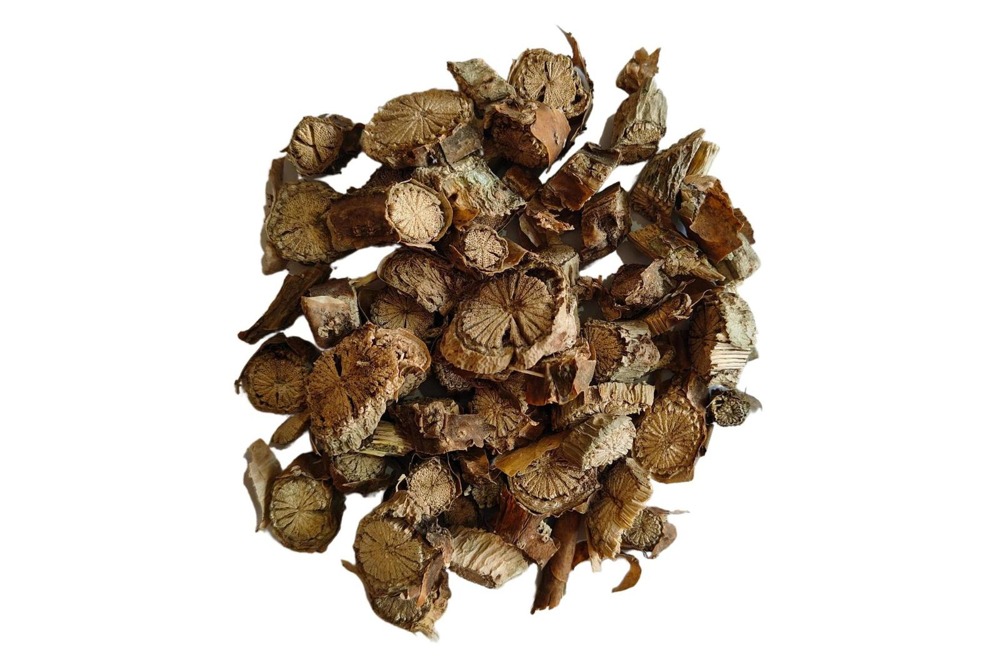
Giloy (Guduchi)
Tinospora cordifolia (Willd.) Miers
Bulk Giloy stem, cut pieces and powder (Tinospora cordifolia) for Ayurvedic, immunity supplement and extract manufacturers sourcing species-verified Guduchi material.
- Botanical nameTinospora cordifolia (Willd.) Miers
- Part usedStem (primary trade grade), leaf, starch extract (Giloy Satva)
- FamilyMenispermaceae
- Also known asGuduchi, Amrita, Amritavalli, Gulvel, Giloe, Gurcha, Amrutaballi, Seendil Kodi, Thippateega, Guluchi, Siddhilata
- Certificate of Analysis
- Samples available
- Export documents handled
Giloy, known in Ayurveda as Guduchi, is the dried stem of Tinospora cordifolia. Demand rose sharply through the pandemic years and has settled into steady volume across immunity supplements and classical Ayurvedic manufacturing.
Botanical identity and part used
Tinospora cordifolia is a perennial climber of the Menispermaceae family, found throughout tropical India. It has heart-shaped leaves and long aerial roots, and older stems show warty circular lenticels on a light brown surface.
The Ayurvedic Pharmacopoeia of India defines Guduchi as dried, matured pieces of stem. Leaf trades separately and at a lower value, and mixing leaf into a stem lot is a recognised trade shortcut buyers should watch for.
The species identity issue buyers must understand
This is the most important sourcing point on Giloy. Tinospora sinensis and Tinospora crispa are both traded in the Indian subcontinent under the names Guduchi and Giloy, but they are different species.
T. crispa in particular has been associated in published literature with liver injury, and several reported safety cases involving Giloy did not verify which species was actually consumed. Sourcing with confirmed species identity is a genuine due-diligence requirement, not a formality. Ask for it in writing.
Where it grows and when it is harvested
Giloy grows wild across tropical India and is also cultivated on trellises. Rajasthan, Madhya Pradesh, Uttar Pradesh, Maharashtra and Gujarat supply most commercial volume.
The Ayurvedic Pharmacopoeia of India specifies collection during summer, preferably in May. Stems collected then carry better bitter content. The fresh drug is also officially recognised, with a moisture content around 75 per cent.
Processing and grades
Stems arrive in pieces of varying thickness, from about 0.6 to 5 cm diameter. Thickness matters commercially: thicker older stems carry proportionally more starchy pith and less bitter fraction, while younger green stems give higher bitters but lower yield by weight.
Guduchi Sattva, sold in the trade as Giloy Satva, is the water-extracted starch fraction and is an officially recognised Ayurvedic preparation in its own right.
Forms that trade
AV Biotech supplies dried stem pieces, cut and sifted stem, and milled powder at 80 mesh. Extract feedstock is graded on stem diameter and bitter potential. Organic-certified lots are available against advance contract.
Industry applications of Giloy
Giloy sells into a narrower set of categories than most Indian botanicals, with Ayurvedic and immunity-positioned nutraceuticals taking the bulk.
Ayurvedic and pharmaceutical manufacturing
The largest consumer. Guduchi is the base of Amritarishta, Amritottara Kvatha Churna, Guduchyadi Churna, Guduchi Taila and Guduchi Sattva.
These units buy cut stem for decoction preparation and coarse powder for churnas, working to Ayurvedic Pharmacopoeia of India limits. Note that Guduchi's official alcohol-soluble extractive minimum is only 3 per cent, which is low for a stem drug and reflects its high starch content.
Nutraceutical and supplement brands
Supplement manufacturers buy 80 mesh powder and standardised extract for immunity-positioned capsules, tablets, effervescents and daily wellness blends. Extracts are commonly standardised on bitters at 2.5 or 5 per cent, referring principally to clerodane diterpenoid lactones such as columbin and tinosporin.
Herbal beverage and food
Giloy goes into kadha and kwath premixes, herbal teas, juices and immunity shots, usually blended with Tulsi, ginger and black pepper. These formats are the most price-sensitive segment and generally buy general commercial powder.
Extract and phytochemical houses
Extraction units buy cut stem in bulk. They grade on stem diameter, bitters potential and, increasingly, on species verification, since the extract cannot be visually identified once processed.
Cosmetic and personal care
A smaller segment. Extract is used in scalp and skin formulations positioned around purifying and soothing action.
Common product formats
- Amritarishta, Guduchyadi Churna and classical kvatha preparations
- Giloy Satva (Guduchi Sattva) starch preparations and tablets
- Immunity capsules, tablets and effervescent formats
- Kadha and kwath premixes, herbal teas and immunity shots
- Giloy juice and ready-to-drink wellness beverages
- Standardised extracts at 2.5 and 5 per cent bitters
- Multi-herb seasonal wellness and daily tonic blends
Traditional use and current research
The Ayurvedic Pharmacopoeia of India lists Guduchi's actions as Rasayana, Balya, Deepana, Sangrahi, Tridoshashamaka, Raktashodhaka and Jvaraghna. Its traditional applications are recorded as Jvara, Kushtha, Pandu, Prameha, Vatarakta and Kamala.
The Sanskrit synonym Amrita, meaning nectar, reflects the regard the herb has held in Ayurveda. The notes below describe traditional positioning and published research directions, not statements of medical outcome.
Seasonal wellness and immunity positioning
This is Giloy's dominant commercial position. The Ministry of AYUSH has identified Tinospora cordifolia as a botanical of interest for antiviral and antimicrobial research. Brands formulate it into products positioned around seasonal wellness and immune support.
Traditional Jvaraghna use
Jvaraghna is the classical Ayurvedic category relating to fever management, and Guduchi has long been used in this context in kvatha and arishta preparations. This is traditional-use positioning and should be described as such.
Metabolic and general tonic formulations
Classical applications include Prameha, a traditional category relating to urinary and metabolic conditions. Modern products using this angle are generally positioned around general metabolic wellness.
Antioxidant activity
Research has examined the plant's alkaloids, glycosides, lactones and polysaccharide fractions including arabinogalactan. Studies suggest antioxidant and immunomodulatory activity in laboratory and animal models.
Skin and blood-purifier positioning
Raktashodhaka, the traditional blood-purifier category, underpins its use in Ayurvedic skin-wellness formulations.
What buyers should note on claims and safety
Published safety discussion around Giloy is closely tied to species identity, because Tinospora crispa has been linked with liver injury while Tinospora cordifolia is the pharmacopoeial species. Any brand carrying Giloy should hold documented species verification for each lot, and should follow current AYUSH and destination-market guidance on labelling and use.
This information is provided for educational and B2B product-sourcing purposes only. It is not medical advice and these statements have not been evaluated by any regulatory authority. Finished-product claims are the responsibility of the manufacturer.
| Botanical name | Tinospora cordifolia (Willd.) Miers, Fam. Menispermaceae |
|---|---|
| Part used | Dried mature stem; leaf quoted separately |
| Appearance | Stem pieces 0.6 to 5 cm diameter, light brown with warty lenticels, radial structure on cut face; powder pale cream to light brown |
| Odour and taste | Faint; taste distinctly bitter |
| Active constituents | Terpenoids and alkaloids (API). Clerodane diterpenoid lactones including columbin and tinosporin, plus berberine, palmatine, magnoflorine and the polysaccharide arabinogalactan. Extracts standardised to 2.5 or 5 per cent bitters |
| Moisture | Not more than 10 per cent for dried stem (typical trade limit). Fresh drug moisture around 75 per cent per API |
| Total ash | Not more than 16 per cent (API limit) |
| Acid-insoluble ash | Not more than 3 per cent (API limit) |
| Foreign matter | Not more than 2 per cent (API limit); screened for leaf and aerial-root content |
| Alcohol-soluble extractive | Not less than 3 per cent (API limit) |
| Water-soluble extractive | Not less than 11 per cent (API limit) |
| Species identity | Tinospora cordifolia confirmed by macroscopic and microscopic examination, screened against T. sinensis and T. crispa. HPTLC or DNA-based identity available on request |
| Stem diameter grading | Available as young thin-stem grade (higher bitters) or general mixed-diameter grade; specify at enquiry |
| Particle size | 80 mesh standard for powder; 20 to 40 mesh cut for decoction and kvatha use |
| Heavy metals | Lead NMT 10 ppm, Arsenic NMT 3 ppm, Cadmium NMT 0.3 ppm, Mercury NMT 1 ppm (AYUSH limits) |
| Pesticide residues | Tested against EU MRL; organic lots screened on a multi-residue panel |
| Microbiology | Total plate count NMT 100,000 cfu/g, Yeast and mould NMT 1,000 cfu/g, E. coli and Salmonella absent |
| Packing | 25 kg HDPE or PP laminated bags with food-grade LDPE inner liner; 40 to 50 kg bales for whole stem; fibre drums on request |
| Shelf life | 24 months for powder, 36 months for dried stem pieces, in sealed original packing |
| Note | All values are typical or indicative. Bitter content varies with stem age, diameter and collection month, and is confirmed on the batch Certificate of Analysis |
Values are typical and indicative. A lot-specific Certificate of Analysis is shared before dispatch.
How do you confirm the material is Tinospora cordifolia and not another Tinospora species?
Every lot is verified by macroscopic and microscopic examination against the pharmacopoeial description and screened against Tinospora sinensis and Tinospora crispa, both of which are traded as Giloy. HPTLC or DNA-based identity confirmation is available on request and we recommend it for extract and export programmes.
Do you supply stem only, or does the lot contain leaf?
Our standard grade is stem only, as defined by the Ayurvedic Pharmacopoeia of India. Leaf and aerial roots are removed at sorting and controlled within the 2 per cent foreign matter limit. Giloy leaf is available as a separately quoted item if you need it.
What is your minimum order quantity for Giloy?
100 kg for milled powder, 250 kg for cut stem, 500 kg for whole dried stem, and 25 kg for standardised extracts. Paid samples of 1 to 2 kg are available for extraction and formulation trials, adjusted against your first commercial order.
Can I specify stem thickness or a bitters level?
Yes. Younger thin stems carry more of the bitter diterpenoid fraction, while thicker older stems carry more starchy pith. Tell us your priority at enquiry and we will grade accordingly. For extracts we supply 2.5 and 5 per cent bitters grades with method stated on the Certificate of Analysis.
What is the typical lead time and best time to buy?
7 to 12 working days for stock grades from Jaipur, and 3 to 4 weeks for organic-certified or species-verified export lots with full identity documentation. The Ayurvedic Pharmacopoeia of India specifies summer collection, preferably May, so freshly collected material enters the market from mid-year.
Enquire about Giloy (Guduchi)
No payment is taken here — this reaches our sourcing team directly.
Related products