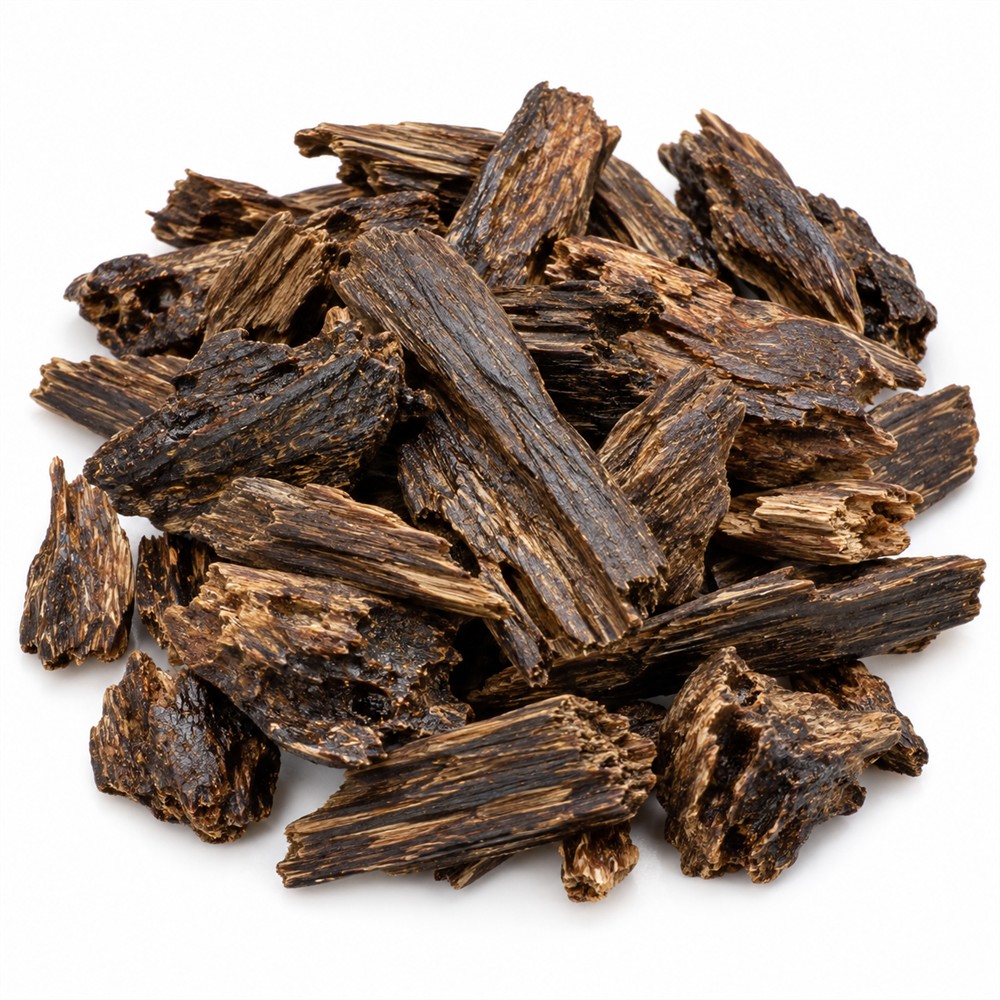
Guggul
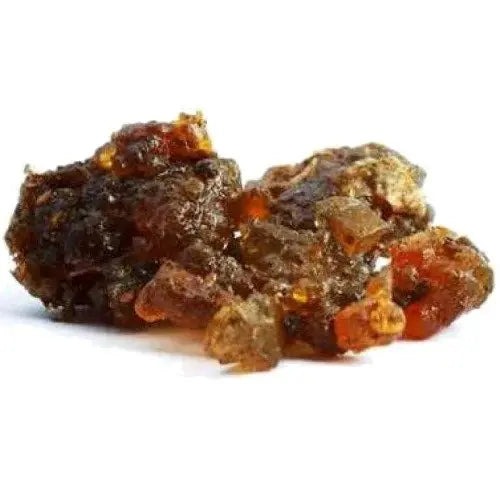
Guggul
Commiphora wightii
Guggul is the oleo-gum resin of Commiphora wightii, supplied in bulk to Ayurvedic manufacturers, joint-health supplement brands and extract houses.
- Botanical nameCommiphora wightii
- Part usedOleo-gum resin (exudate from stem and branches)
- FamilyBurseraceae
- Also known asGuggulu, Gugal, Guggal, Mahishaksha, Kanchan Guggul
- Certificate of Analysis
- Samples available
- Export documents handled
Guggul is not a leaf or a root. It is the oleo-gum resin that seeps from cuts in the stem and branches of Commiphora wightii, so it is bought, tested and stored differently from ordinary dried herbs.
Botanical identity
Commiphora wightii (Arn.) Bhandari belongs to the Burseraceae family, the same family as myrrh and frankincense. The older synonym Commiphora mukul still appears on many labels and specifications.
The plant is a thorny, slow-growing shrub or small tree adapted to hyper-arid conditions. It holds a central place in Ayurveda, where the resin is called Guggulu.
Where it comes from
Wild populations are largely restricted to the dry regions of Rajasthan and Gujarat, and to bordering areas of Pakistan. Within Rajasthan, the resin has historically come from Jaisalmer, Barmer, Bikaner and Jodhpur.
Studies comparing wild populations found some of the highest guggulsterone readings in samples from Devikot in Jaisalmer and Palana in Bikaner. Origin genuinely affects the material.
AV Biotech is based in Jaipur, inside the main producing state, which shortens the distance between the collection areas and the buyer.
Conservation and legal sourcing
This is the most important commercial point about guggul. Commiphora wightii was assessed as Critically Endangered on the IUCN Red List, following an estimated population decline of more than 80% over three generations.
The decline is attributed to heavy commercial demand, destructive tapping, habitat loss and very poor natural regeneration. Responsible buyers should therefore ask for documented legal origin and prefer material from cultivated plantations or regulated, non-destructive tapping.
Non-destructive tapping methods have been developed specifically to allow resin collection without killing the plant. We recommend buyers write source documentation into the purchase specification rather than treating it as optional.
Tapping and processing
Resin is collected by making incisions in the stem and branches, mainly in the cooler months. The exudate hardens into pale yellow to brown tears and lumps, which darken with age.
Raw resin arrives mixed with bark, sand and soil because it is sticky and picks up field debris. Cleaning, hand sorting and sieving are therefore a real part of the value we add before dispatch.
Raw versus purified guggul
Ayurvedic manufacturing distinguishes raw guggul from purified guggul, prepared by a traditional process called shodhana. Purification is done using media such as Triphala decoction, cow's milk or cow's urine, depending on the formulation.
The two materials are not interchangeable. Decide which you need before you enquire, because the specification, the price and the downstream handling all change.
Active constituents
The compounds of commercial interest are E-guggulsterone and Z-guggulsterone, along with related guggulsterols. Levels in raw resin are low, so guaranteed percentages are supplied as standardised extract rather than as raw gum.
Industry applications of Guggul
Guggul serves a wider range of industries than most people expect, and the lower grades have real markets of their own.
Ayurvedic and herbal pharma
This is the largest segment by volume. A whole class of classical Ayurvedic preparations is built around the resin and is named after it, the guggulu kalpas.
Well-known examples include Yograj Guggulu, Kaishore Guggulu, Triphala Guggulu, Simhanad Guggulu and Mahayogaraj Guggulu. These manufacturers normally buy purified (shodhit) guggul, or buy raw resin and carry out shodhana in house.
Nutraceutical and supplement brands
Supplement makers formulate guggul extract into tablets, capsules and softgels positioned around joint comfort and metabolic wellness. Almost all of this segment works from standardised extract.
Extract specifications are written against guggulsterones, commonly at 2.5%, with higher levels available. Confirm whether a figure is by HPLC or by UV, because the two methods do not give the same number for the same material.
Extract and phytochemical manufacture
Extract houses buy cleaned raw resin as feedstock. They care about resin fraction, low sand content and consistent guggulsterone readings rather than about appearance.
Incense, dhoop and aroma
Guggul is a traditional temple resin and burns with a distinctive balsamic aroma. Incense, dhoop cone and havan sambrani manufacturers are steady buyers, and this segment can often use grades that do not meet pharmaceutical cleanliness limits.
Personal care and oral care
Formulators use guggul extract in oral care powders and pastes, in massage and joint-care balms, and in traditional cosmetic bases. Inclusion is usually low, and the resinous aroma has to be accounted for in the fragrance brief.
Common product formats
- Classical guggulu tablets and vati in Ayurvedic manufacturing
- Standardised guggul extract capsules, tablets and softgels
- Joint-care balms, oils and topical creams
- Incense sticks, dhoop cones and havan mixtures
- Ayurvedic tooth powders and oral care formulations
- Isolated guggulsterones for reference standards and research use
Traditional uses and current research
Guggul is one of the most-referenced resins in Ayurveda and has been in continuous use for a very long time. That history, rather than any modern claim, is the basis of most of its demand.
Traditional positioning
Traditionally used in Ayurveda in formulations addressing medoroga, a classical term relating to excess body tissue, and in preparations directed at joint comfort and mobility.
Classical texts also describe guggul as a yogavahi, a carrier substance thought to help direct the action of the other herbs it is combined with. This is why it so often appears as the base of a multi-herb tablet rather than on its own.
Traditional practice always calls for purification before internal use. Raw resin is described as harsh, and shodhana is intended to make it suitable for formulation.
What studies suggest
Guggulsterones are the most studied constituents. Research has examined their possible influence on lipid metabolism and on inflammatory pathways, with results that are mixed and not settled.
Studies suggest guggulsterones may interact with nuclear receptor signalling, which is one proposed mechanism for the effects reported in earlier work. Findings vary considerably with the extract used and its standardisation level.
Because trials have used quite different preparations, evidence from one extract cannot be assumed to apply to another. Manufacturers should align their own material with the literature they intend to reference.
How brands position finished products
Commonly formulated into products targeting joint comfort, healthy lipid levels, weight management support and general Ayurvedic wellness. Claim wording must comply with the destination market's rules.
In India these are governed by the Drugs and Magic Remedies (Objectionable Advertisements) Act, FSSAI nutraceutical regulations and AYUSH licensing requirements.
Points buyers should note
Guggul is known to interact with certain prescribed medicines, and formulators generally review this before launching a consumer product. Suitability during pregnancy is also normally assessed at the formulation stage.
Independent testing of market samples has found real quality problems, including undetectable guggulsterone in some brands and lead above permitted limits in others. Heavy metal testing on every lot is a practical necessity, not a formality.
This information is provided for educational and B2B product-sourcing purposes only. It is not medical advice and these statements have not been evaluated by any regulatory authority. Finished-product claims are the responsibility of the manufacturer.
| Botanical name | Commiphora wightii (Arn.) Bhandari (syn. Commiphora mukul) |
|---|---|
| Family | Burseraceae |
| Part used | Oleo-gum resin exuded from incisions in stem and branches |
| Appearance | Pale yellow to reddish-brown irregular tears, lumps or agglomerated masses; darkens with age |
| Odour and taste | Characteristic balsamic aromatic odour; bitter, acrid taste |
| Active constituents | E-guggulsterone and Z-guggulsterone; guggulsterols; gum fraction; volatile oil |
| Guggulsterones (raw resin) | Low and variable, typically under 0.1% total E+Z; not suitable as a guaranteed assay basis |
| Extract standardisation | 2.5%, 5% and 10% total guggulsterones; state HPLC or UV, as results differ by method |
| Water-soluble gum fraction | Typically 30% to 60% of the crude resin |
| Alcohol-soluble resin fraction | Typically 20% to 40% of the crude resin |
| Volatile oil | Typically 0.4% to 1.5% |
| Moisture | Not more than 10% (typical) |
| Total ash | Not more than 5% for cleaned resin (typical) |
| Acid-insoluble ash | Not more than 2% (typical); the key indicator of sand and soil pick-up |
| Foreign matter | Not more than 2% for cleaned grade; bark, stone and sand removed by hand sorting |
| Particle size | Natural tears and lumps; graded nuggets; powder at 40 to 60 mesh, cold-milled with a permitted flow agent |
| Heavy metals | Lead, cadmium, mercury and arsenic tested on every lot; strongly recommended for this material |
| Pesticide and microbiology | Tested against buyer-nominated panel; total plate count, yeast and mould, E. coli, Salmonella |
| Source documentation | Legal-origin declaration provided; cultivated or regulated non-destructive tapping preferred |
| Packing | 25 kg HDPE drums or fibre drums with food-grade liner; resin is sticky and needs rigid packing |
| Shelf life | 36 months in sealed original packing, stored cool; lumps may soften and fuse in high heat |
Values are typical and indicative. A lot-specific Certificate of Analysis is shared before dispatch.
What is your minimum order quantity for guggul?
MOQ is 50 kg for raw and cleaned oleo-gum resin, and 25 kg for purified (shodhit) guggul or standardised extract. The lower MOQ on purified and extract grades reflects their higher value. Samples of 100 to 250 g are available so you can assess colour, aroma and sand content before ordering.
Do you supply raw guggul or purified (shodhit) guggul?
Both, and they are ordered separately because they are not interchangeable. Raw cleaned resin suits extract houses and manufacturers who run their own shodhana. Purified guggul, prepared using traditional media such as Triphala decoction or milk, suits manufacturers going straight into classical guggulu tablets. Please state your shodhana medium if it is specified in your product licence.
How do you handle the conservation status of Commiphora wightii?
The species is listed as Critically Endangered on the IUCN Red List, so sourcing documentation matters. We supply legal-origin declarations with each lot and prioritise material from cultivated plantations and regulated, non-destructive tapping. We recommend you write this documentation requirement into your purchase specification.
Why can't you guarantee a guggulsterone percentage on raw resin?
Guggulsterone levels in crude oleo-gum resin are naturally low and vary widely with population, season and tapping method. Published surveys of wild populations show large differences between collection sites. For a guaranteed figure such as 2.5% or 5% total guggulsterones, we supply standardised extract and state whether the assay is by HPLC or UV.
What quality checks should a buyer insist on for guggul?
Ask for acid-insoluble ash, because guggul is sticky and picks up sand and soil during collection. Insist on heavy metal testing on every lot, since independent surveys of market samples have found lead above permitted limits. Also request identity testing, as adulteration with cheaper gums and resins is a known issue in this trade.
Enquire about Guggul
No payment is taken here — this reaches our sourcing team directly.
Related products