Safed Musli
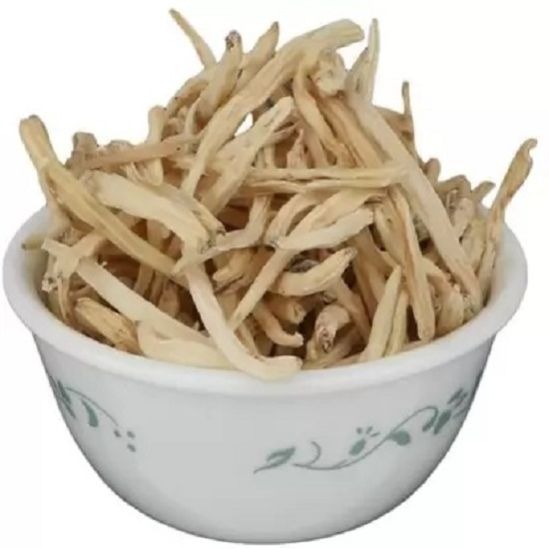
Safed Musli
Chlorophytum borivilianum Santapau & R.R.Fern.
Dried roots of Chlorophytum borivilianum, the saponin-bearing safed musli sourced in bulk by Ayurvedic, nutraceutical and extract manufacturers.
- Botanical nameChlorophytum borivilianum Santapau & R.R.Fern.
- Part usedDried tuberous roots (fingers)
- FamilyAsparagaceae (formerly placed in Liliaceae)
- Also known asSafed Musali, Dholi Musli, Shweta Musli, Swetha Musali, Taniravi Thang, Musli sufaid
- Certificate of Analysis
- Samples available
- Export documents handled
Safed Musli is the dried tuberous root of Chlorophytum borivilianum Santapau and R.R. Fern., a herb of the Asparagaceae family. The roots grow in a cluster of fleshy fingers below a short crown. AV Biotech supplies whole dried fingers, cut and sifted, powder and standardised extract.
Species identity is the first thing to fix
Safed Musli is one of the most substituted botanicals in the Indian trade, and the substitutes are not all cheap fakes. Several look and sell alike.
Chlorophytum tuberosum and Chlorophytum arundinaceum are related species with lower saponin levels. Asparagus adscendens is a different genus sold under the same common name in some regions. Kali musli, Curculigo orchioides, is an entirely separate plant.
Ask for a root-only, species-specific declaration and a TLC identity profile against a reference sample. That single request removes most of the risk in this material.
Cultivation and where it comes from
Commercial Safed Musli is cultivated rather than wild-collected, which is important because the wild plant is under pressure. Southern Rajasthan, western Madhya Pradesh and northern Gujarat are the traditional core, with Maharashtra and Chhattisgarh adding volume.
Planting follows the monsoon in June and July. Foliage dies down towards the end of the season, and the roots are left in the ground through January and February. Harvest runs from around March to April.
Processing, and why the drying matters
Fresh root loses a large share of its weight on drying. Field data commonly puts around 2,000 kg of fresh root per hectare at roughly 400 to 500 kg dried, so a fresh-to-dry ratio near five to one is normal.
Roots are washed, the crown is removed, and material is peeled or left unpeeled. Peeling speeds drying and gives the white finish buyers associate with premium grade. Unpeeled root retains slightly better keeping quality.
Correct drying is partial shade at roughly 35 to 40 degrees C over three to four days, spread thin and stirred. That regime holds the white colour. Material dried badly turns yellow or brown, and some sellers then whiten it with sulphur fumigation.
That practice is the main hidden defect in this trade. Ask for a sulphur dioxide residue figure on any unusually bright white lot.
Constituents and grades
Total saponins in the root are reported across a wide band, from about 2 up to 17 per cent depending on species, age and analysis method. Commercial dried root commonly assays in the low single digits by gravimetric method. Extracts are standardised at 10, 20 or 40 per cent saponins.
Grading in trade uses colour and finger size, usually described as A, B and C. Buyers should note that gravimetric saponin figures and colorimetric figures are not interchangeable, so the method belongs on the specification.
Industrial applications of Safed Musli
Safed Musli is a high-value root with a narrower buyer base than the myrobalans, but a demanding one. Almost every buyer works to an assay.
Ayurvedic and pharmaceutical manufacturing
Safed Musli belongs to the vajikarana group of classical Ayurvedic materials, associated with vitality and strength. It goes into churna, tablets, capsules, avaleha and medicated ghrita and taila. Powder at 80 mesh is the working grade for tablet and capsule lines.
Whole and cut fingers are used where a decoction or milk-based preparation is made. Some classical formats call for the root to be lightly roasted before powdering.
Nutraceutical and sports nutrition
This is the fastest-growing outlet and it buys extracts, not raw powder. Standardisation is usually on total saponins by gravimetric method, commonly at 10, 20 or 40 per cent. Sports and vitality brands blend it with Ashwagandha, Gokshura, Shilajit and Kaunch beej.
These buyers routinely require identity confirmation, an irradiation declaration and a non-GMO statement before shipping.
Food, beverage and health drinks
Powder is used in health-drink premixes, malt-based beverages and functional food blends. The root is starchy and carbohydrate-rich, so it disperses well in milk-based products. Fine milling and low microbial counts are the key requirements.
Veterinary and animal nutrition
Coarse powder is used in cattle and poultry vitality premixes, and in dairy productivity blends. This segment takes lower-grade and off-size fingers, which helps the overall economics of a crop.
Cosmetic and personal care
Root extract appears in rejuvenating and firming skin formulations and in some hair preparations. Volumes here are small compared with the supplement trade.
Common product formats we supply into
- Safed Musli churna, tablets and capsules
- Vitality and stamina supplement blends
- Sports nutrition and men's wellness formulations
- Health drinks, malt premixes and nutrition powders
- Avaleha, medicated ghrita and taila preparations
- Standardised saponin extracts at 10, 20 and 40 per cent
- Milk-decoction and ksheerpaka style products
- Cattle and poultry vitality premixes
- Rejuvenating skin and hair formulations
- Ayurvedic proprietary tonics and syrups
Traditional uses and research context
Safed Musli is classified in Ayurveda within vajikarana, the group associated with vitality, and within balya, associated with strength. It has been used in Indian traditional medicine for centuries and is now widely traded as a supplement ingredient.
Vitality and stamina traditions
Safed Musli is traditionally used in Ayurveda in preparations intended to support vitality, stamina and reproductive wellness. This remains its dominant commercial positioning worldwide. Brands commonly formulate it into products targeting energy, endurance and men's wellness.
Studies suggest that the steroidal saponin fraction is associated with these effects in animal models. Human evidence is limited and mostly small in scale.
General strength and recovery formulations
The classical balya designation places Safed Musli alongside herbs used to support physical strength. Sports nutrition brands formulate it into recovery and performance blends, usually in combination with Ashwagandha and Gokshura. Positioning in these products is typically around general strength support rather than any specific performance outcome.
Antioxidant and immunomodulatory research
Research suggests that the saponins and polysaccharides in Chlorophytum borivilianum show antioxidant and immunomodulatory activity in laboratory and animal models. This has drawn interest from general wellness and immunity formulators. Findings remain pre-clinical.
Nutritive and restorative use
The root is naturally rich in carbohydrates including fructan-type polysaccharides, with a modest protein fraction. Traditional preparations often combine it with milk or ghee, reflecting its use as a nutritive restorative. Modern health-drink premixes follow the same logic.
Notes for formulators
Safed Musli is usually formulated at gram-level daily doses in churna form, and at much lower levels when a standardised extract is used. Because vitality and performance claims are tightly controlled in most export markets, review label wording with your regulatory team. Adulteration risk in this material makes documented species identity a safety matter as well as a commercial one.
This information is provided for educational and B2B product-sourcing purposes only. It is not medical advice and these statements have not been evaluated by any regulatory authority. Finished-product claims are the responsibility of the manufacturer.
| Botanical name | Chlorophytum borivilianum Santapau and R.R. Fern. (Asparagaceae) |
|---|---|
| Part used | Dried tuberous roots only, crown removed |
| Appearance | Whole: creamy white to pale ivory fingers, 4-10 cm long, 4-10 mm thick, slightly wrinkled and hard. Powder: off-white to pale cream |
| Odour and taste | Faint characteristic odour; slightly sweet, mucilaginous taste |
| Identity | TLC identity against Chlorophytum borivilianum reference; root-only and species declaration issued per lot. Common substitutes are Chlorophytum tuberosum, Chlorophytum arundinaceum, Asparagus adscendens and Curculigo orchioides |
| Active constituents (typical assay) | Total saponins in dried root reported from about 2% to 17% depending on species, age and method; commercial root commonly assays in the low single digits by gravimetric method. Extracts standardised at 10%, 20% or 40% saponins, gravimetric. Also contains fructan-type polysaccharides, carbohydrates around 40-45% and protein around 5-9% |
| Moisture / loss on drying | Not more than 10% (typical 6-9%) |
| Total ash | Not more than 5% (typical trade limit for cleaned root) |
| Acid-insoluble ash | Not more than 1% (root crops carry field soil, so this is the parameter to watch) |
| Foreign matter | Not more than 2%, including crown, rootlet and other plant parts |
| Sulphur dioxide residue | Tested on request. Unusually bright white lots should always be checked, since sulphur fumigation is sometimes used to mask poor drying |
| Particle size | Powder 60, 80 or 100 mesh BSS to order; cut and sifted 2-6 mm; whole fingers graded A, B and C by colour and size |
| Heavy metals | Lead NMT 10 ppm, Arsenic NMT 3 ppm, Cadmium NMT 0.3 ppm, Mercury NMT 1 ppm (API / WHO basis, by ICP-MS) |
| Pesticide residues | EU MRL screen (Reg. 396/2005) available on request |
| Aflatoxins | B1 not more than 5 ppb, total not more than 10 ppb (EU herbal-material basis) |
| Microbiology | Total plate count NMT 10^5 cfu/g; yeast and mould NMT 10^3 cfu/g; E. coli, Salmonella, S. aureus and P. aeruginosa absent |
| Packing | 25 kg paper-laminated or HDPE bags with food-grade LDPE liner; 20-25 kg fibre drums for powder and extract |
| Shelf life | 36 months for whole and cut roots; 24 months for powder, in original sealed packing |
Values are typical and indicative. A lot-specific Certificate of Analysis is shared before dispatch.
How do I know the material is genuine Chlorophytum borivilianum?
Ask for a TLC identity profile against a reference sample plus a written root-only, species-specific declaration, both of which we issue per lot. Related species such as Chlorophytum tuberosum and Chlorophytum arundinaceum look similar but assay lower, and Asparagus adscendens is sold under the same common name in some regions. Curculigo orchioides, or kali musli, is a different plant altogether.
The sample looks very white. Is that a good sign?
Not always. Correctly shade-dried roots are creamy white to pale ivory, not brilliant white. Brilliant white sometimes indicates sulphur fumigation used to mask poor drying, so we recommend a sulphur dioxide residue test on any unusually bright lot. We can run that test and report it on the certificate of analysis.
What saponin content can you supply, and by which method?
Raw dried root commonly assays in the low single digits by gravimetric method, with published ranges for the species running much wider. Standardised extracts are supplied at 10, 20 or 40 per cent total saponins, gravimetric. Always state the method on your purchase order, because a gravimetric figure and a colorimetric figure are not comparable numbers.
When is fresh crop available and how far ahead should I book?
Roots are left in the ground through January and February and harvested from about March to April, so fresh-crop material arrives from April onward. Book eight to ten weeks ahead for large tonnages or organic-certified lots, since the harvest window is short. We hold buffer stock through the year for smaller repeat orders.
Do you supply peeled or unpeeled roots, and does it matter?
Both. Peeled roots dry faster and give the white finish premium powder and export buyers expect. Unpeeled roots keep marginally better and are usually fine for extraction and feed applications, at a lower price. Tell us the end use and we will recommend the grade rather than defaulting to the most expensive one.
Enquire about Safed Musli
No payment is taken here — this reaches our sourcing team directly.
Related products